How To Prioritize Customer Journeys
Also in 2026, prioritizing journeys remains a high stakes activity: Pick the wrong journeys, and breed stakeholder skepticism about journey transformation instead. Pick the right journeys, and build a killer success story, nurturing buy-in and gaining momentum on the path to CX improvements.
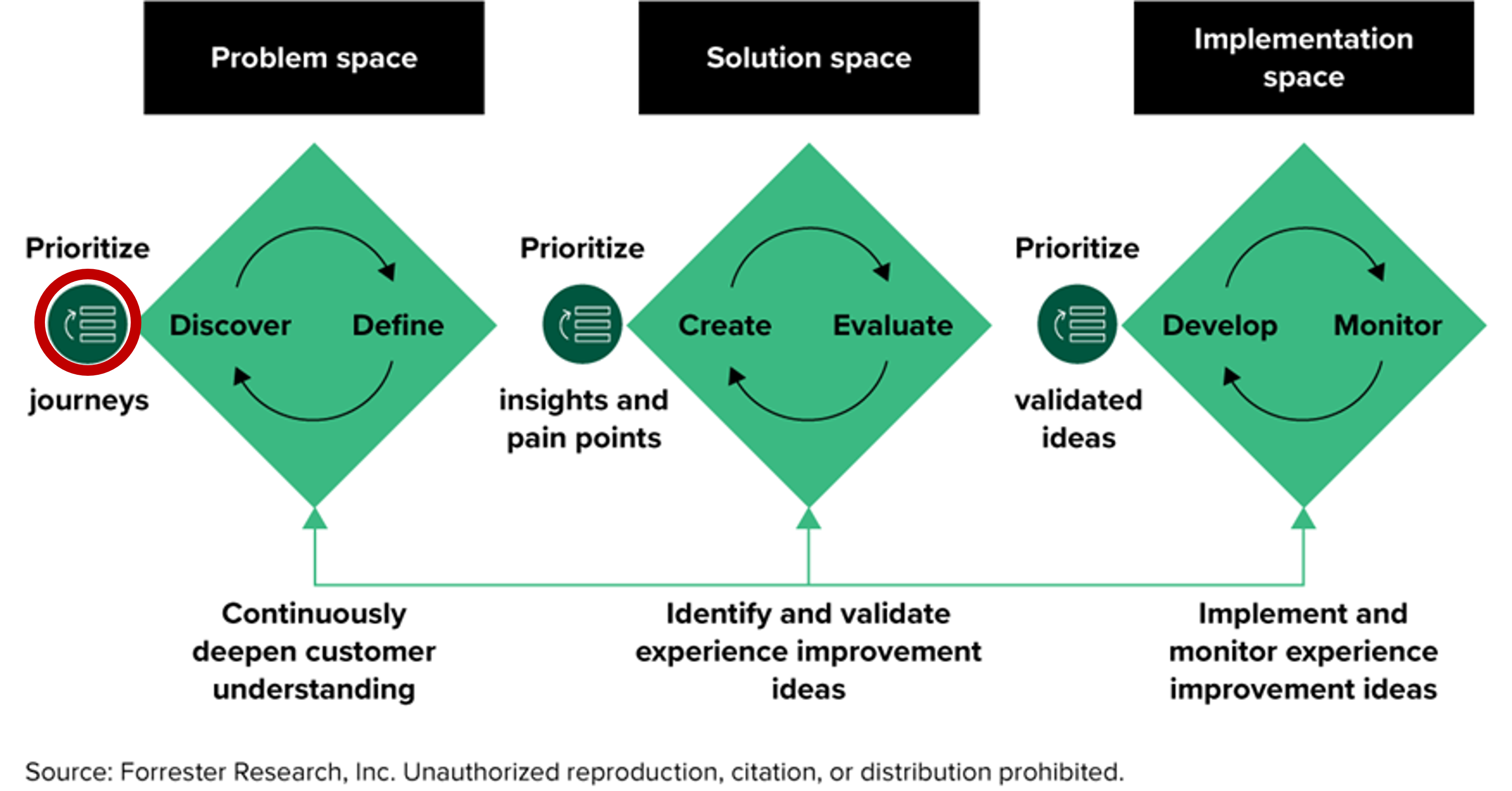
Use A Prioritization Tool To Build A Portfolio Of Journeys
In our newly updated report, How To Prioritize Customer Journeys, we lay out our recommendations for how to best prioritize journeys. Here are the top ones:
Aim For A Portfolio Of Journeys By Considering Available Resources
That portfolio should include journeys at various levels of impact and feasibility so that you don’t get stuck in “quick-win land.” Overfocusing on quick wins (high impact and feasibility) can be dangerous. These fixes may be easy, but CX leaders should also work on some long-term investments and strategic bets.
Organizations often start with two or three journeys, then take on more as they gain experience. Classify each journey as described below, then focus on long-term investments, quick wins, and strategic bets. Next, consider the resources (time, budget, full-time equivalents [FTEs]) available across the organization and on the CX team that can be dedicated to advancing your portfolio of journeys. Finally, pick as many journeys as you can accomplish with your available resources across long-term investments, some quick wins, and some strategic bets.
Create A Long List Of Journey To Assess – Using Your Journey Atlas If You Have One
Always start from this definition of a customer journey: Customer journeys are customers’ paths and perceptions as they pursue a goal
That means journeys can – and often do – include interactions with people and firms other than your organization. If you’re already organizing your journeys in a customer journey atlas — AKA a journey collection, catalog, or library — start with that. A journey atlas identifies and organizes the journeys of specific customer groups along their customer lifecycle, and it lets you visualize how multiple journeys interrelate. If you don’t have a journey atlas yet, we recommend creating one as it will help you create a shared framework and language that facilitates communication with stakeholders about journeys.
Secure Buy-in By Bringing In Stakeholders Early
Smart CX leaders involve key stakeholders and executive sponsors in defining prioritization criteria and applying them to score journeys. The critical individuals to pull into this work are: 1) business leaders who are responsible for the touchpoints, systems, and people affected — and who will approve solutions and provide resources; 2) subject matter experts who understand or interact with customers and can help create the map and set the right context; 3) facilitators who will help organize and execute the effort; and 4) implementers (e.g., developers, program managers, designers) who will be involved when you move from insights to action.
Rate Impact And Feasibility Across 10 Dimensions
Prioritize journeys to work on by evaluating their
- impact on customers, employees or partners, business goals, cross-journey impact, brand differentiation, and strategy
- feasibility in terms of internal awareness and support, required investment and measurability, complexity, access to organizational gesources, and CX team resources and skills.
Below you find an overview of all criteria you can use across the 10 dimensions and in yellow boxes those that we recommend firms use when they are starting out with their journey prioritization work.
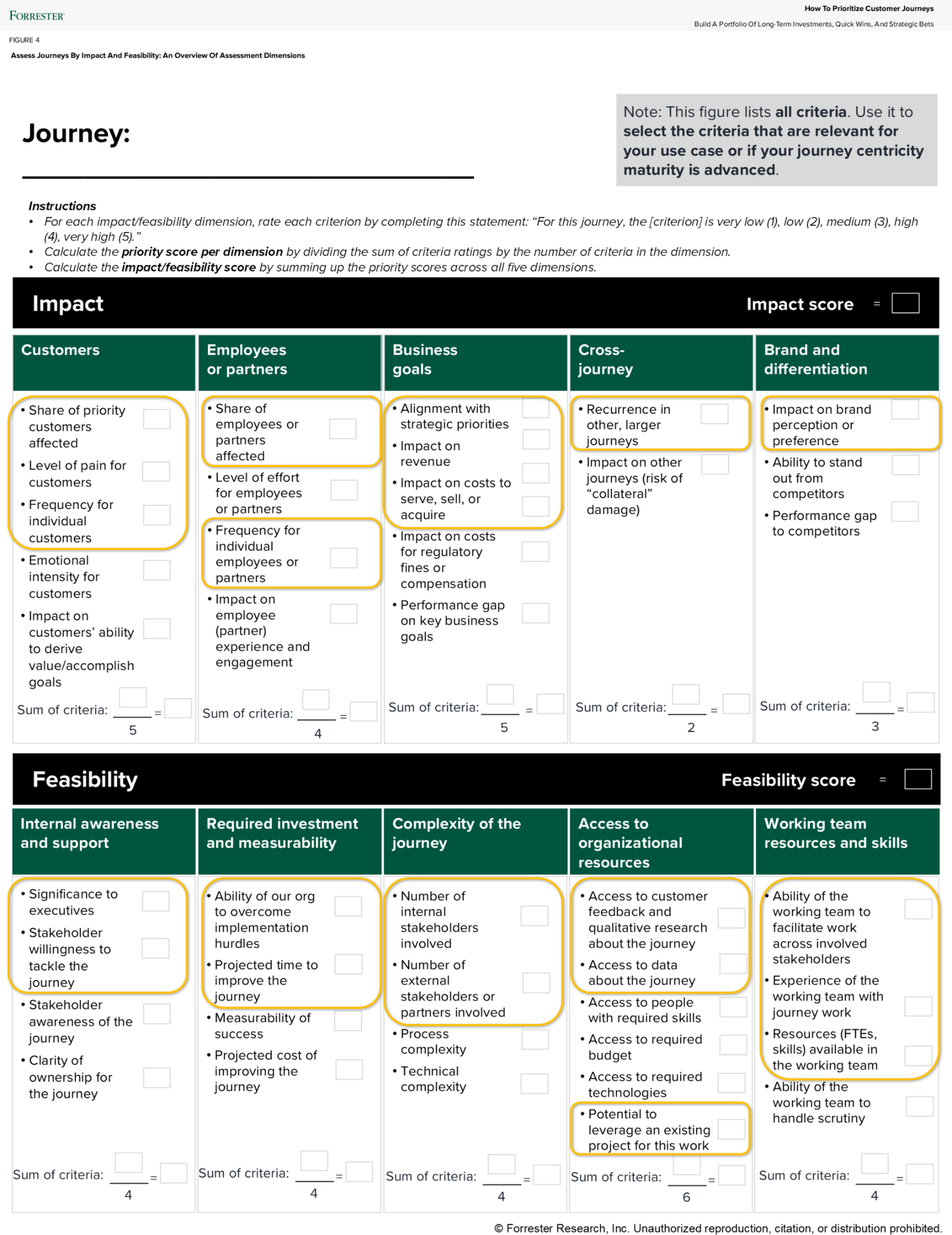
How to use this? Follow the the instructions in the figure to calculate a score per dimension, then aggregate those to a score for impact and a score for feasibility. These scores will be between 5 and 25 for each axis. Plot the journeys you are assessing on a 2 by 2 of impact and feasibility with axes going from 5 to 25.
Note that we also created an excel tool for journey prioritization that you can still find on Forrester.com but we recommend using the simpler approach in this report.
We thank Lorenzo Introna, Susan McNulty, and Judy Weader for their contributions in developing the report.