Manufacturing’s AI Future Will Be Decided At The Gemba
Like us, you’ve probably noticed that over the past two years, most discussions about AI in manufacturing have focused on what LLMs can do for engineers, planners, and other knowledge workers. Vendors have showcased copilots that summarize documents, answer questions, and generate content. Those capabilities matter, but they may not be where manufacturers ultimately realize the greatest business impact.
Our forthcoming research on frontier AI in manufacturing starts with a simple hypothesis: Manufacturers will create more value when AI participates directly in operational decision loops than when it’s used primarily for information retrieval and content generation. Models alone don’t create outcomes. The real value lies in the workflows, governance, and execution capabilities they enable. To deliver those outcomes at scale, manufacturers need platforms that connect AI to operations execution.
The Next AI Battleground Is The Gemba: Why Industrial AI Must Move To The Edge
Lean practitioners use the term gemba to describe the place where value is created. For manufacturers, that means production lines or cells, warehouses, maintenance workshops, logistics hubs, and service operations. It’s where manufacturers diagnose equipment failures, mitigate quality or safety and compliance risks or exceptions, adjust production schedules, prioritize maintenance interventions, manage supply disruptions, and coordinate service responses. Manufacturers make these decisions continuously and under time pressure. A maintenance technician troubleshooting a critical asset, a supervisor responding to a quality issue, or a planner managing a production disruption can’t always afford cloud latency, connectivity dependencies, or lengthy processing cycles. For them, speed, context, resilience, and trust often matter more than model scale.
Bigger Models Aren’t Always Better: Moving From Edge Analytics To Edge Intelligence
There’s a wealth of AI industry commentary about powerful frontier models. But manufacturing use cases often focus on variables that models overlook — factors such as predictable response times, operational resilience, or cost efficiency. That’s why manufacturers tend to deploy frontier AI models as part of a broader architecture rather than treat them as a universal solution. The emerging pattern resembles an intelligence hierarchy:
- Frontier models provide reasoning, planning, and orchestration.
- Domain-specific industrial models contribute manufacturing expertise.
- Smaller edge-resident models provide fast, local decision support (e.g., for maintenance and safety).
- Optimization engines enforce engineering, operational, and business constraints.
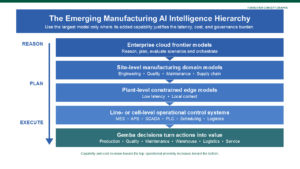
The future factory will rely on multiple forms of intelligence working together rather than a single dominant AI model.
In earlier research, we explored the importance to operational resilience of low-latency analysis and rapid response. But now we have new digital industrial platforms and AI deployments like Siemens Industrial Edge or Schneider Electric and Microsoft combining industrial automation, agentic AI, and edge-aware architectures.
Please look out for our forthcoming research on constrained language models and the operations edge examining opportunities for smaller, specialized models to provide conversational interaction, contextual reasoning, and tightly governed decision support directly within factories, warehouses, and supply chain operations. In the meantime, we’re interested in hearing your perspective on AI deployment patterns and AI governance. Please feel free to schedule a guidance session or inquiry call.