Performance Marketing Is Dead — Here’s Why
An account is visiting your website. Several contacts have downloaded content. You triangulate intent signals with third-party insights. Sales conversations are underway. Your demand dashboard looks promising.
But does the buying group prefer your company, or are they leaning toward a competitor?
Yesterday’s Playbook Doesn’t Work For Today’s Buyers
The question of preference is more urgent than ever. For most companies, the answer will undermine conventional thinking about how B2B buyers make decisions and select vendors. It will change how you interpret your pipeline and where you invest your marketing budget. Engagement tells you that buyers are interacting. Understanding preference, however, helps you assess whether those interactions are happening from a position of strength. The gap between them is the death knell for so-called “performance marketing.”
Buyers now form preferences long before a formal purchase process begins. Peer conversations, thought leadership, analyst perspectives, and other experiences (yes, even display ads) shape which providers they trust and favor. Those early preferences matter because they are also durable. According to Forrester’s B2B buyer research, the initial preferred vendor wins the business 55% of the time on average.
Preference Marketing Drives Real Performance
That’s why we advise clients to invest in preference marketing, a strategic approach that gives B2B marketing leaders a practical way to connect brand and demand, prioritize opportunities, and decide what to do next.
For marketing and sales leaders, the implication is clear. Building preference before a buying group forms is as important as conventional demand generation and conversion activities. Measuring these efforts separately obscures how they contribute to the same outcome: being chosen.
Forrester’s Preference Marketing Matrix connects two dimensions: market preference, which reflects how strongly buyers favor your company and its offerings, and buying group interaction, which assesses whether the right people are meaningfully engaging and progressing toward a purchase decision.
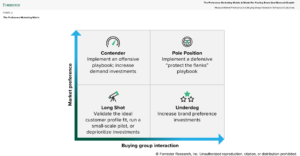
Together, these dimensions reveal four positions, each calling for a different response:
- Pole position: high preference, high interaction. You have an advantage and an active buying group. Protect and advance that position with customer proof, validation, executive engagement, and support for the stakeholders involved in the decision.
- Contender: high preference, low interaction. Buyers favor your company, but that preference has not yet translated into active buying group interaction. Focus on relevant triggers and targeted demand programs that help activate the opportunity.
- Underdog: low preference, high interaction. Buyers are engaging, but their activity may overstate your competitive position. Strengthen preference through differentiation, credible evidence, trust, authority, and a compelling case for choosing your company.
- Long shot: low preference, low interaction. Both conditions need work. Make deliberate choices about where to build relevance, where to narrow your target audience, where to sustain investment, and where to deprioritize.
The Best Time To Get Started Is Now
You don’t need perfect data to begin. In our report, The Preference Marketing Matrix: A Model For Fueling Brand And Demand Growth, we outline a pragmatic, incremental approach to measure both dimensions, from using available business and engagement signals to developing richer brand research and buying group intelligence.
Marketing and sales should, in concert, define priority segments, align account strategies, and agree on the actions each opportunity needs based on preference position. Take note of whether a position on the matrix changes what your teams do next and the incremental returns that result.
Forrester clients can read the full report and schedule a guidance session to explore the measurement approaches, investment choices, and activation steps you should take to put buyer preference at the center of your brand and demand strategy.
Related Forrester Content