Retail’s Incremental Total Experience Shift: Select Brands See Significant Improvement
Forrester assessed 41 major US retailers for our Total Experience Score to determine how well brands win and serve customers. Retailers have work to do: The average Total Experience Score across all retailers was a mere 59.1 on a 100-point scale. Still, retail did improve compared to last year, increasing a statistically significant 0.4 points over the industry average in 2025. Additionally, six individual retail brands improved significantly year over year.
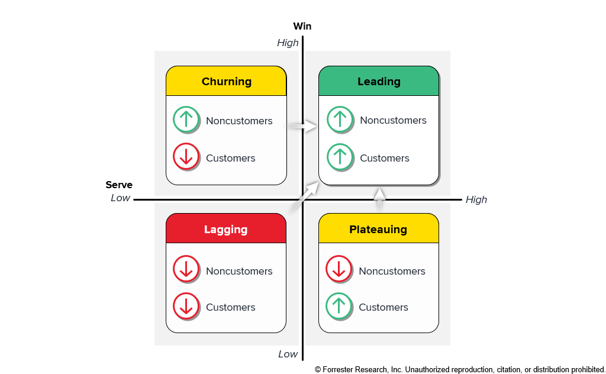
Forrester’s Total Experience Score maps businesses into four quadrants: lagging, churning, plateauing, and leading. The leading quadrant houses the brands that are most successful for both axes that we measure: winning customers and serving customers.
The Improvements Are Real But Uneven
A small group of retailers made meaningful gains in their Total Experience Scores year over year. A total of 11 brands are in the “leading” quadrant, up from nine in 2025. Retailers that saw positive improvement this year include Tractor Supply Co., Kroger, Costco Wholesale, and Walmart. Chewy retained its top score among retailers (65.5).
Retail consistently scores lower on average than some other industries, but these modest improvements indicate that consumers are more willing to express more pleasure with their retail interactions and assumptions.
The Fundamentals Still Decide Outcomes
Retailers that score well are those that are building strong fundamentals, not necessarily those carving a completely new path to selling. For CX, the highest-ranking driver that impacted customers’ scores is “offers the products/services that I want.” For brand experience (BX), “has high-quality products/services” is the highest-ranking driver for customers, and “offers the products/services that I want” is the highest for noncustomers.
Consumers award higher scores to retailers that simply have the appropriate product assortment, which is in stock and of the expected quality. Retailers that deliver products and services that consumers want are poised to win and retain customers. When the fundamentals are strong, customers’ experiences build loyalty.
Employee Experience Fuels Better Customer And Noncustomer Experience
In 2026, Forrester added employee experience (EX) to the total experience assessment. When employees have the tools, leadership, and support they need, retailers are better able to deliver consistent customer and brand experiences. Among the retailers with the five top Total Experience Scores in 2026, three have positive EX impact.
What Leaders Should Do Next
In a market that seems to constantly insist that there is some new technology, process, or pressure that brands must adopt immediately, it may be a relief to learn how heavily the fundamentals weigh in consumer sentiment. The path to improvement doesn’t require adding something completely new. It just requires positive customer (and noncustomer) experiences.
In addition to shoring up fundamentals, retailers can improve their Total Experience Scores when they:
- Align experience across functions. Connect BX, CX, and EX efforts so they reinforce each other instead of competing.
- Treat EX as an execution lever. Invest in tools, leadership, and enablement that directly improve delivery.
- Focus on consistency. Close gaps across journeys and channels where experiences break down.
Let’s Connect
For a deeper dive into the Total Experience Score results of 41 major US retailers, check out Forrester’s US Retailers Total Experience Score Rankings, 2026. Book a guidance session to discuss these results further and apply them to your organization — regardless of whether you’re one of the retailers in our research.