AMD’s AI Strategy Is Shifting From Chips To Systems
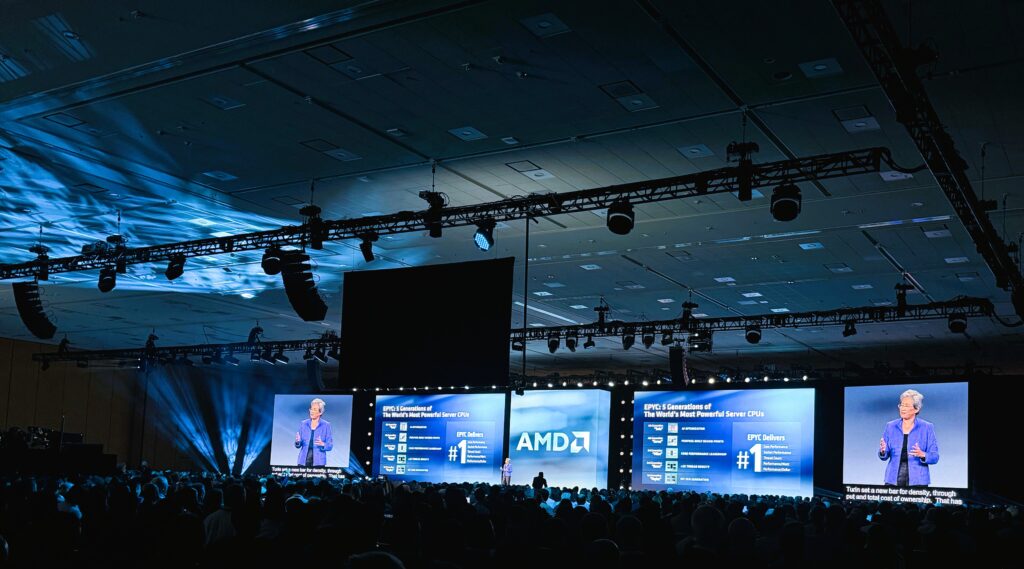
At AMD’s Advancing AI event in San Francisco, I expected to hear about faster GPUs, next-generation CPUs, AI PCs, and the company’s latest AI infrastructure roadmap.
Those announcements certainly happened. AMD introduced new AI infrastructure, processors, software, and AI PC capabilities. But the most important message wasn’t about a specific product. It was about positioning: AMD is evolving from a semiconductor company into an enterprise AI systems company.

That distinction matters, because enterprise AI success is becoming less dependent on individual components and more dependent on how organizations deploy, orchestrate, govern, and optimize AI across increasingly complex environments. Throughout the event, AMD consistently emphasized system-level optimization, hybrid AI, deployment services, software, and ecosystem partnerships alongside silicon innovation.
For CIOs and digital workplace leaders, that strategic shift may ultimately matter more than any benchmark.
Enterprise AI Has Entered Its Systems Era
For years, infrastructure decisions often centered on hardware specifications, pricing, lifecycle management, and vendor relationships. AI changes the conversation.
Today’s infrastructure choices increasingly influence developer productivity, operational efficiency, governance, security, inference economics, and business outcomes. As AI adoption moves from experimentation to operational scale, three themes emerged from AMD’s vision:
- AI spending is becoming inference first. Organizations are increasingly focused on operationalizing AI rather than training foundation models. Across executive presentations, AMD repeatedly emphasized throughput, responsiveness, inference performance, and tokens per dollar as key buying criteria. This reflects a broader market shift. For most enterprises, the challenge is no longer building models but determining how to run AI efficiently and economically at scale.
- Agentic AI raises the infrastructure bar. The next wave of AI will not consist of isolated copilots. Agentic AI introduces complex workflows involving multiple agents, models, data sources, and orchestration layers operating simultaneously. Supporting these workloads requires coordinated optimization across compute, networking, storage, memory, and software. That makes infrastructure architecture increasingly strategic. Organizations can no longer evaluate AI systems component by component.
- Infrastructure is becoming an operational platform. Perhaps most notably, AMD discussed governance, deployment, observability, intelligent workload routing, and developer experience almost as frequently as hardware performance. That reinforces an increasingly important reality: Enterprise AI success depends on operating AI effectively, not simply acquiring AI infrastructure.
AMD Is Expanding Beyond Silicon
AMD’s product announcements pointed to a broader strategic shift. Rather than positioning CPUs, GPUs, networking, and software as standalone offerings, the company consistently presented them as components of an integrated AI platform designed to simplify enterprise AI deployment and operations.
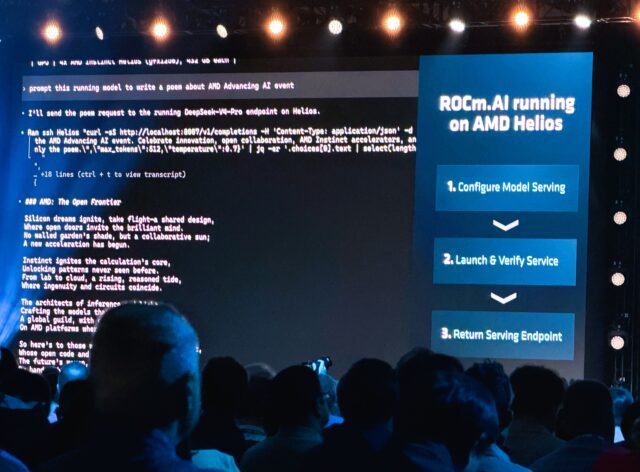
- Helios exemplifies the systems approach. More than a new rack-scale architecture, Helios combines EPYC CPUs, Instinct GPUs, networking, software, and rack-level design into a unified AI platform. The focus is on delivering a complete enterprise AI system rather than optimizing individual components.
- Software is becoming a strategic differentiator. AMD devoted significant attention to AI-assisted optimization, developer tooling, and software portability — including a large focus on its open-source, AI-native developer experience platform and driver stack, ROCm.AI. Rather than competing solely on hardware performance, AMD is investing heavily in reducing deployment friction and simplifying developer experiences.
The bottom line: AMD’s differentiation strategy is increasingly centered on integrated AI systems and operational simplicity, not silicon alone.
AI Won’t Live Only In The Data Center
A notable takeaway was AMD’s view that enterprise AI will be inherently distributed. Rather than assuming that AI workloads belong exclusively in public clouds or centralized infrastructure, AMD described a future where intelligence spans AI PCs, edge devices, enterprise infrastructure, and cloud environments.
- Hybrid AI is becoming the enterprise architecture operating model. In this model, workloads move dynamically based on factors such as cost, latency, performance, security, and governance requirements. Intelligent workload routing has the potential to improve responsiveness while helping organizations manage rapidly growing inference expenses.
- Local AI is gaining renewed business relevance. As cloud AI costs continue to rise, organizations are reassessing where AI workloads should run. AMD’s vision aligns with a broader enterprise trend toward evaluating local processing, on-device AI, and on-premises inference for select use cases. For CIOs, the opportunity is not to replace the cloud but to identify where hybrid deployment models can improve economics, strengthen governance, and deliver better user experiences.
AI PC Adoption Continues To Accelerate
AI PCs are entering a new phase of enterprise adoption. As adoption accelerates, enterprise leaders are moving beyond device specifications and focusing on how AI PCs fit into broader AI operating models, workforce strategies, and investment priorities.
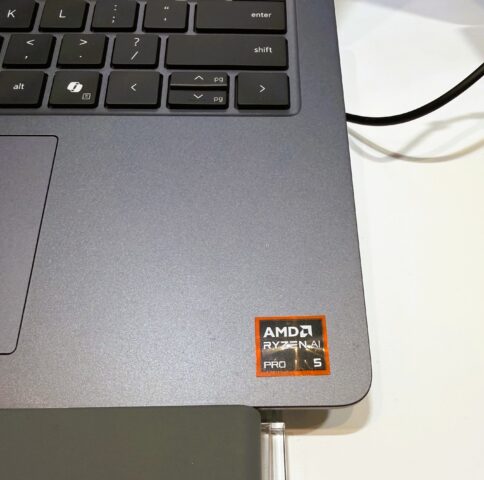
- The challenge is no longer about whether to deploy AI PCs. Organizations are increasingly focused on identifying the employee personas that create the strongest business case, the use cases that justify premium AI-capable devices, and how success should be measured. For many CIOs and digital workplace leaders, the next phase of AI PC adoption will depend less on technical capability and more on aligning investments to employee productivity, workflow transformation, and measurable business outcomes.
- AI PCs must become part of a broader AI architecture. AMD executives openly discussed the need for improved deployment frameworks, simplified user experiences, and intelligent workload orchestration across devices, data centers, and cloud environments. That’s an important signal. The long-term value of AI PCs may ultimately depend less on processor benchmarks and more on how effectively organizations determine where AI workloads should run and how seamlessly those workloads move across a distributed AI ecosystem.
The future of AI PCs won’t be decided by what’s inside the device. It will be decided by how well organizations integrate those devices into their broader AI strategy.
No Vendor Will Win AI Alone
AMD is betting on ecosystem strength, not just product strength. Throughout the event, the company emphasized that enterprise AI success requires collaboration across model providers, software vendors, cloud platforms, and infrastructure partners.
- Partnerships are becoming strategic assets. AMD highlighted deeper collaboration with Anthropic, Meta, and OpenAI around future architectures, software optimization, and large-scale deployments. These relationships increasingly resemble co-engineering partnerships rather than traditional supplier arrangements.
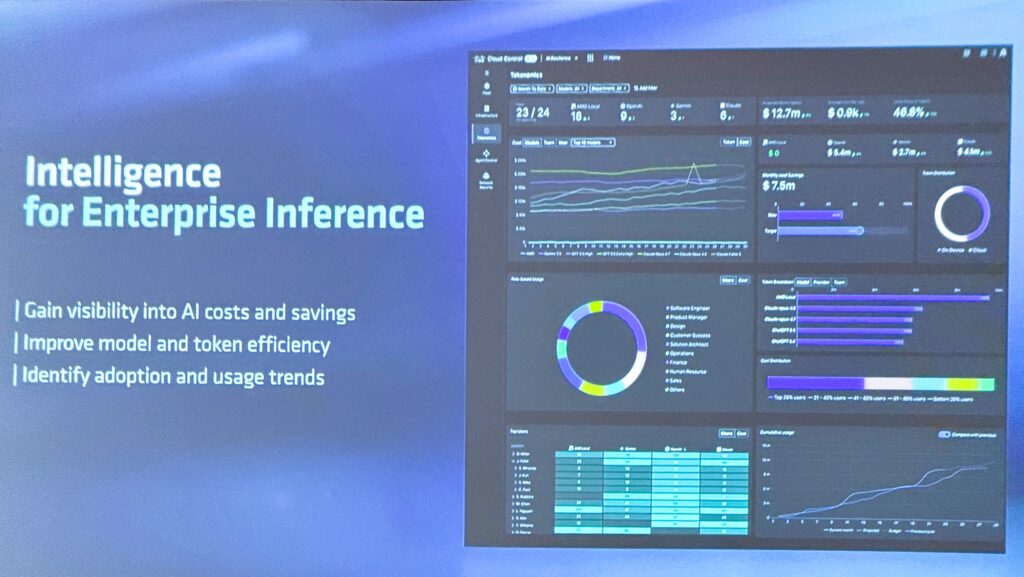
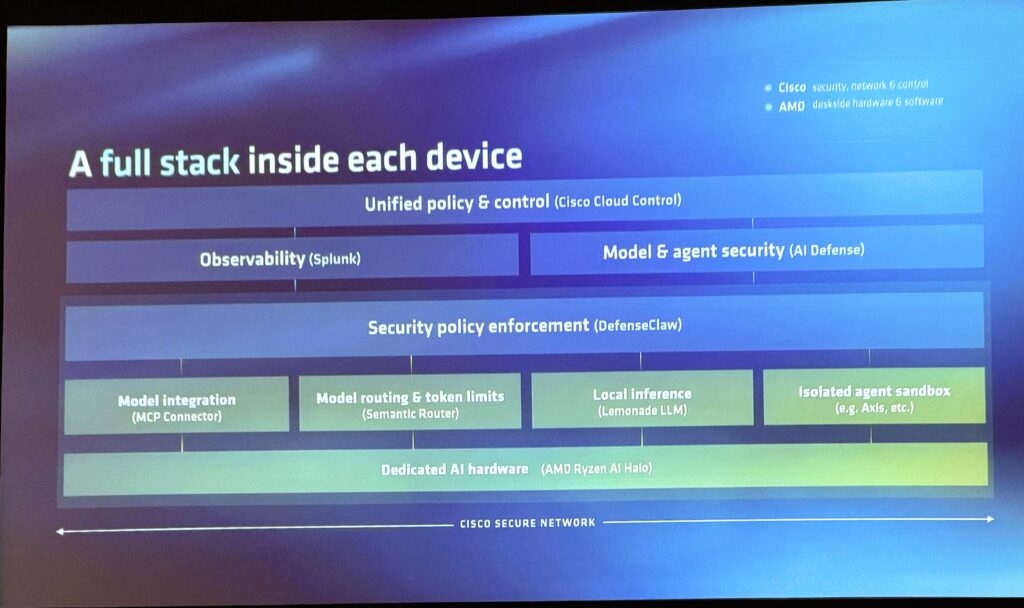
- Cisco expands AMD into enterprise AI operations. Among the announcements, the Cisco partnership was particularly interesting. Rather than focusing exclusively on infrastructure, the companies described capabilities spanning secure hybrid AI, intelligent routing, governance, token management, and observability across distributed AI environments.
- Open ecosystems remain central to AMD’s differentiation. Across software, networking, developer tooling, and hardware, AMD repeatedly reinforced openness as a competitive advantage — reducing vendor lock-in while enabling OEMs, hyperscalers, enterprises, and software providers to build differentiated solutions on top of AMD’s architecture.
As AI deployments become more complex, the competitive advantage may come less from what vendors build themselves and more from the ecosystems they enable.
The Real Opportunity For AMD
AMD’s strategy is compelling, but execution will matter. Historically, much of the company’s digital workplace presence came through OEM relationships. AI changes that dynamic. As infrastructure decisions become more strategic, enterprise buyers increasingly expect vendors to connect technology investments to business outcomes.
AMD has made significant progress expanding its narrative beyond chips. The next step is demonstrating how system-level innovation translates into employee productivity, operational efficiency, governance improvements, customer experience gains, and measurable business value.
After all, CIOs don’t invest in tokens, throughput, or accelerators. They invest in outcomes.
My Take
The biggest announcement at AMD’s Advancing AI event wasn’t a GPU, CPU, or AI PC. It was a strategic repositioning.
AMD will start to compete as an enterprise AI systems company, not simply a semiconductor provider. That systems-first approach reflects where the market is headed. As enterprise AI adoption expands, organizations will care less about individual components and more about how effectively AI can be deployed, governed, optimized, and scaled across diverse environments.
For CIOs and digital workplace leaders, that’s the development worth watching.
If you’re developing an AI PC strategy, evaluating hybrid AI architectures, preparing for agentic AI, or identifying high-value workplace AI use cases, schedule a guidance session to discuss how these trends may impact your technology roadmap, employee experience strategy, and future-of-work initiatives.
Related Forrester Content
Categories
- Agentic AI
- AI model
- Application Development & Delivery
- Architecture & Technology Strategy
- Automation
- development & operations (DevOps)
- Emerging Technology
- employee experience
- enterprise architecture
- Future of Work
- infrastructure & operations
- open source AI
- operationalizing innovation
- Partner Ecosystems