The Most Expensive Customer Complaint Is The One You Ignore
In April 2026, a JetBlue customer posted a public complaint about a sudden $230 fare increase. JetBlue replied with a well‑intentioned suggestion: Try clearing cookies or booking in an incognito browser. The exchange was quickly screenshotted, shared thousands of times, and swept into a national debate about “surveillance pricing.” Lawmakers weighed in. A proposed class‑action lawsuit followed.
The incident wasn’t really about cookies or pricing algorithms. It was about complaint management and what happens when organizations underestimate the costs embedded in customer complaints.
Complaints Carry Higher Stakes Than Other Forms Of Feedback
Complaints are not just negative feedback. They arise when customers believe something has gone wrong and expect the organization to act. That expectation fundamentally raises the stakes. Emotions run higher, time pressure increases, and trust becomes fragile.
Yet many organizations still treat complaints as routine service issues or compliance activities to close quickly and report upward. They focus on minimizing volumes and meeting procedural standards, often without asking what complaints reveal about deeper experience, policy, or process failures.
The JetBlue example shows the danger of that mindset. The fallout didn’t come from the original issue alone. It escalated because the complaint was handled as a routine interaction rather than as a high‑risk moment requiring judgment, coordination, and care.
The Biggest Costs Rarely Show Up On Complaints Dashboards
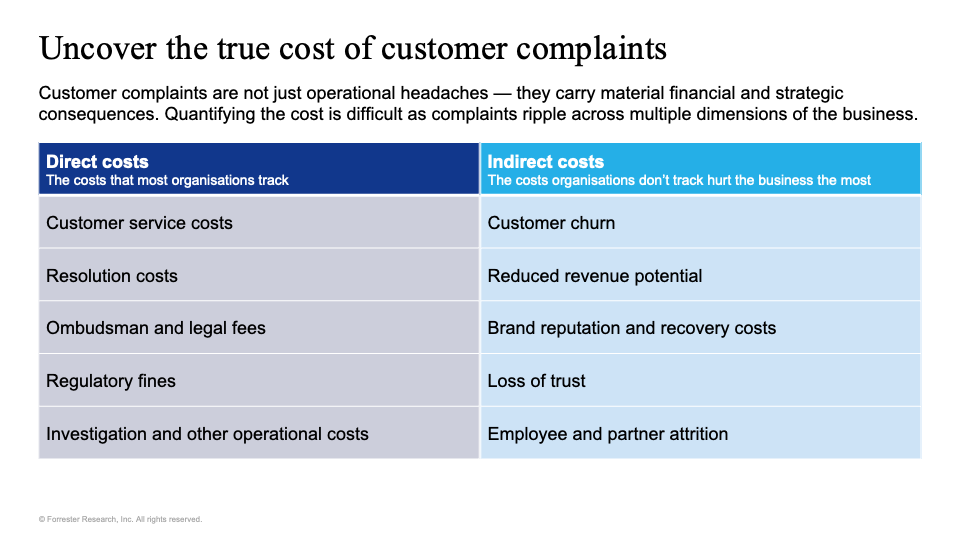
Most business leaders track the direct costs of complaints: agent time, refunds, credits, or escalation handling. These matter, but they’re rarely the biggest issue. The greater damage is indirect and cumulative:
- Customer churn and reduced future revenue from unresolved systemic issues
- Brand damage as complaints surface publicly
- Employee burnout from repeated firefighting without root‑cause fixes
This is why regulators increasingly warn that low complaint volumes can be a red flag, masking disengagement rather than signaling healthy experiences.
From Business Liability To CX Capability
Leading firms make a strategic shift. They stop asking how to reduce complaints and start asking what complaints can do for the business — repairing relationships, redesigning CX, strengthening culture, and reducing risk.
To learn how to quantify the true cost of complaints and turn them into a strategic CX capability, read my report The Business Case For Customer Complaint Management (paywall). It’s the first in a broader series of Forrester research on complaints management. It will be followed by The Customer Complaints Management Business Case Builder (an upcoming tool to help CX leaders model costs, benefits, and ROI) and Customer Complaints Management Best Practices (an upcoming report detailing the people, process, and technology required to run complaints management as a mature CX capability). If you’re interested in participating in this research, including interviews or case studies, I’d welcome you to reach out to me directly at rpasto@forrester.com.
I’m also running a hands‑on workshop on building the business case for complaints management at Forrester’s CX Summit EMEA in Amsterdam this June 9, where we’ll work through practical examples and application of the framework with industry peers. Hope to see you there!