Trustworthy AI Won’t Scale Without A New Quality Playbook: Forrester Offers One
AI Trust Starts Before Production
AI-infused applications are moving into production faster than most enterprises can prove that they are safe, reliable, explainable, or even useful. This gap is now one of the biggest barriers to scaling AI. Our report, Trustworthy AI Starts With Testing And Evals, Not Deployment, makes a simple but urgent call to enterprises: You must engineer AI through continuous testing, AI evals, red teaming, human review, governance controls, and production telemetry for success.
AI-infused applications fail in ways traditional software does not. For CIOs and application development leaders, this changes the quality conversation. Classical software testing still matters — deeply. Functional regression, performance, security, accessibility, integration, and user experience testing remain foundational. But AI applications can also produce nondeterministic outputs, retrieve the wrong information, use tools incorrectly, follow risky agent trajectories, drift over time, or create biased and unsafe responses while appearing confident and polished. You must take a different approach to making them production-ready.
Forrester’s Continuous Testing Loop Makes Evals An Engineering Discipline
Development organizations need a broader quality model, with more expanded categories than “pass/fail.” “Does the code behave as specified?” must become “Does the AI-enabled system behave acceptably across business context, user intent, model behavior, policy boundaries, and changing production conditions?” This is where AI evaluations (evals) become essential. Evaluations translate desired behavior into repeatable measurement (e.g., through question/answer pairs). They assess accuracy, relevance, groundedness, refusal behavior, bias, toxicity, retrieval quality, prompt robustness, agent tool use, and business-task completion.
The mistake many organizations make is to treat evals as a research or model-team activity, which they are not. Evals must be developed alongside the AI-enabled application and become reusable engineering assets. They must be versioned and governed like test suites, mapped to product risk, and embedded into delivery pipelines. High-risk AI use cases require stronger release gates, deeper human review, adversarial testing, and post-deployment monitoring. Low-risk use cases may need lighter controls, but they still need defined success criteria and observable behavior.
Testing And AI Validation Markets Will Converge
This shift toward testing nondeterministic systems will also reshape the vendor landscape. We expect convergence between classical testing vendors and AI evals and validation companies. Testing vendors bring enterprise-grade assets: test management, automation, CI/CD integration, governance, reporting, service virtualization, synthetic data, and quality engineering workflows. AI evals and validation specialists bring model- and agent-specific capabilities: prompt and response evaluation, retrieval assessment, safety testing, hallucination detection, red teaming, observability, and continuous model-performance monitoring. Buyers will not want two disconnected quality stacks for long.
The winners will be those that unify these disciplines into one lifecycle view of quality for AI-infused applications.
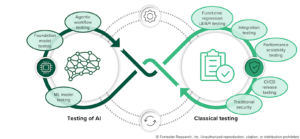
Expect classical testing platforms to add eval orchestration, LLM observability, prompt/version traceability, risk-based AI release gates, and model behavior dashboards. Expect AI validation vendors to move closer to enterprise QA, test-case management, compliance evidence, defect workflows, and portfolio-level reporting. Partnerships, acquisitions, and platform extensions will accelerate because the market need is clear: Continuous AI quality assurance must connect development, testing, risk, security, data, and operations.
What Technology Leaders Must Do Now
The ecosystem is changing around you. What should you do now?
- Inventory AI-infused applications by business risk, not technical novelty.
- Define what “good” and “unsafe” behavior mean for each use case.
- Build evals as living assets, not one-off experiments. Leverage existing process information to accelerate eval development (e.g., a catalog of common customer questions).
- Connect classical testing, AI evals, red teaming, human review, and production telemetry into a continuous feedback loop.
- Assign ownership — trustworthy AI is not just the model team’s job; it is a shared product-delivery responsibility.
The bottom line: AI trust is earned before, during, and after deployment. Organizations that master continuous testing and evals will move faster because they can prove when AI is ready, know when it is drifting, and respond before failures become business incidents. Companies that keep treating AI testing as a pre-launch checklist will discover that speed without evidence is not innovation — it is unmanaged risk.
Forrester clients can schedule a guidance session or inquiry with Diego Lo Giudice or Rowan Curran to discuss how to build trustworthy AI testing and eval practices. Vendors offering tools in this space, or clients with mature practices in this space, can also request a briefing to share their approach to AI evals, validation, testing, observability, and governance.
Related Forrester Content
Categories