
From CRM To The Agentic Enterprise: Salesforce’s Biggest Dreamforce 2026 Reveals
At Dreamforce 2026, Salesforce presented its most complete vision yet for the “agentic enterprise.” It shifted the core focus away from individual apps (such as those focused on sales, services, or marketing) and unified them through a single architecture built around data, logic and AI agents.
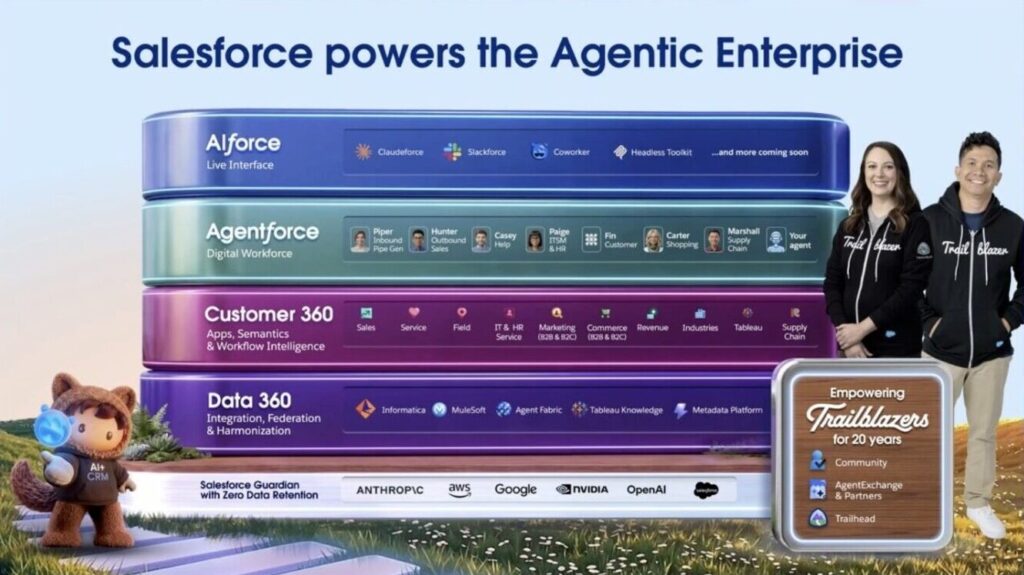
This vision includes: (1) AIforce, Salesforce’s UX layer that is no longer isolated to the traditional Salesforce UX and includes its Headless construct; (2) Agentforce, its agentic layer, which now includes autonomous agents like Hunter for sales, Casey for service, and many more that can complete workflows across application borders; (3) Customer 360, the workflow layer that includes familiar CRM apps (e.g., the sales, services, marketing, and commerce apps); and (4) Data 360, which unifies structured and unstructured data and knowledge across apps.
Although the keynotes focused heavily on Salesforce technology, partners and consultancies also shared the stage, highlighting that partner ecosystem strength is a critical enabler in creating customer value, not only to deploy agents but to redesign work.
Salesforce Expands Its Core CRM Footprint In All Directions — Mainly By Acquisitions
Salesforce highlighted recent acquisitions that strengthen its CRM core, such as Fin for customer self-service; Qualified for conversational marketing and sales pipeline generation; Contentful for content management; and Momentum for revenue orchestration. They will remain standalone for the foreseeable future. Customers should understand the roadmaps, tactical transition plans, and pricing for these acquired products before committing to them.
In addition, key questions remain in terms of how customers can take full advantage of Salesforce’s new architecture, given current and past investments in legacy apps. For example, it’s still early days for Salesforce Marketing Cloud customers who have adopted the new version of Engagement (ExactTarget) that enables them to leverage Data 360, Flow, and Agentforce. Questions remain on how to evolve other modules such as Personalization (Evergage), Marketing Cloud Intelligence (Datorama), Salesforce’s own Loyalty Management solution, and Contentful to Salesforce’s new architecture.
AIforce Evolves Salesforce’s CRM Beyond Its Traditional UX
AIforce was the centerpiece of Dreamforce 2026. It extends Salesforce beyond its traditional UX by making its data, workflows, governance, and business logic accessible through Slack, Claude, and continuing support for Salesforce’s native UX, Lightning. It is built on Headless 360, a platform architecture that exposes Salesforce capabilities as APIs, Model Context Protocol (MCP) tools, and command-line interfaces. A packaged offering called Claudeforce combines 37 sales skills inside of Claude. This strategy reflects Salesforce’s belief that future enterprise value resides in trusted data, process logic, and its security model rather than the CRM UX itself.
Slack Makes AI A Multiplayer Experience
Slack occupied an increasingly strategic position at Dreamforce. During the Slack keynote, Boris Cherny, creator and head of Claude Code, said that approximately 90% of his coding takes place in Slack because the shared environment allows others to see, guide, and contribute to the work. Slack Code, Slackforce, the AI-enhanced Slackbot, and integrations with Claude move AI beyond single-user interactions toward what Salesforce calls “multiplayer AI.”
We expect this trend to spread as more “multiplayer” AI agents enable multiple simultaneous users to collaborate (with agents and humans) in a shared chat channel persistently. But it’s not perfect. Permissions, in particular, are a challenge. Before IT teams let everyone leap in, admins should try out multiplayer AI themselves and try to break it.
Agent Governance And Orchestration Take Center Stage
Salesforce is developing the capabilities needed for a holistic agentic AI platform: Agent Fabric (now rebranded to drop “MuleSoft”) for agent governance; Slack for humans in the loop; and Agentforce for agentic runtime/orchestration. It is unclear, however, whether Salesforce can deliver that holistic agentic platform, raising concerns that the vision could become a collection of loosely integrated products.
Koa Brings CRM-Specific Reasoning To Salesforce
Salesforce introduced Koa, its first CRM-specific reasoning model. It is built with NVIDIA to help AI agents execute CRM workflows such as opportunity management, case routing, and policy-guided decision-making. Salesforce believes that enterprise AI will require specialized models alongside general-purpose foundation models. This strategy gives customers (particularly those in regulated industries) a model trained on decades of CRM data. It also gives them greater control over model deployment and governance. Organizations should focus not only on model performance but also on governance, evaluation, human oversight, and measurable business outcomes when deploying AI agents.
Pricing Offers More Choice But Not Necessarily Lower Costs
Salesforce also emphasized new pricing models. Its new Core, Advanced, and Max editions bundle AI, Slack, analytics, security, and Flex Credits. This gives customers everything they need to experiment with and scale agents, easing adoption hurdles, but this does not necessarily mean lower costs, and pricing may be untenable for buyers looking for smaller and/or more traditional CRM deployments. In all cases, buyers should negotiate usage, conversions from older license constructs, price protections, and explicit definitions of billable actions before deploying agents broadly.
The Bottom Line
Salesforce deserves credit for presenting a more coherent architecture built around four layers: AIforce, Agentforce, Customer 360, and Data 360. Together with past investments in MuleSoft, Informatica, Slack, and its expanding partner ecosystem, Salesforce is assembling many of the components required for a comprehensive agentic AI platform.
The challenge now is proving that all the pieces work together as seamlessly as the strategy suggests. Questions remain around the future of standalone data products, the integration of acquired technologies, and how existing customers will transition from today’s application-centric model to tomorrow’s headless, agent-driven architecture.