Why Business Leadership Is The Deciding Factor In API Success
Every year, enterprises invest millions in APIs, yet many end up with brittle interfaces nobody wants to reuse. The root of this problem is usually how the program is led rather than the technology. When business leadership is missing, APIs devolve into integration glue. They connect systems, but they don’t create momentum. Solution architects build them only to satisfy immediate needs, with little thought to reuse of APIs for long‑term value. Each new API adds tech debt. Over time, this API portfolio becomes an anchor instead of a flywheel — something leaders work around rather than something that compounds value with every new use.
APIs Are Not Just Technology Assets
APIs can and should be business assets. But APIs behave differently from physical goods that most product executives manage. They are nonrival, meaning one consumer’s use does not prevent another’s. Once built, they scale at near‑zero marginal cost. They enable network effects by facilitating value exchange across ecosystems. Business APIs reward scale, reuse, and optionality rather than fixed plans. They allow organizations to unbundle business capabilities and recombine them quickly as markets shift. In uncertain environments like we’ve lived in since 2020, that flexibility is not a “nice to have”; it’s a competitive necessity.
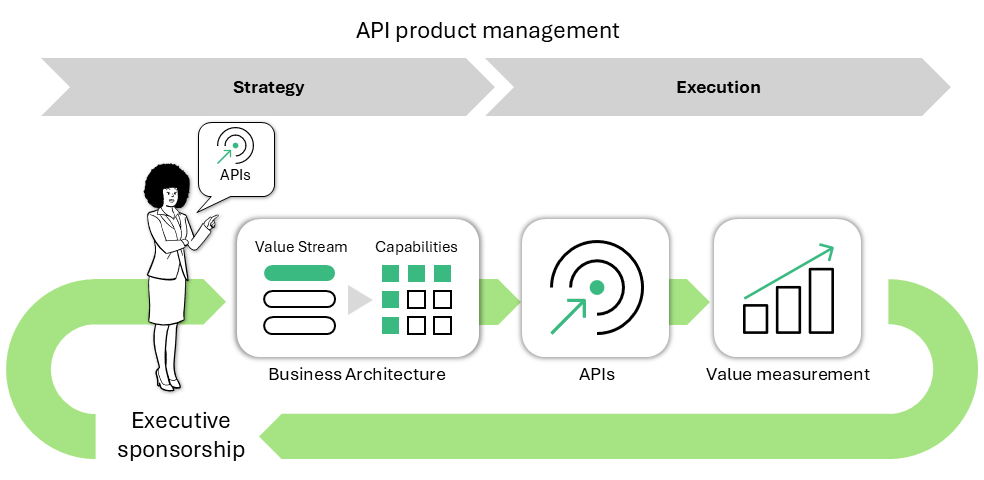
This is why API strategy cannot be delegated to IT teams alone. My research has identified four essential components for establishing successful business leadership in API programs:
- Executive sponsorship. Strong sponsors establish API‑based strategic objectives and lead the necessary culture change. A senior business leader must set direction for APIs and own outcomes. Without a top‑down mandate, APIs drift away from strategic targets. But with the right executive direction, APIs unlock new business opportunities. For example, as nonrival goods, APIs have low to no marginal costs. ROI depends on scale and network effects unlimited by the physical constraints of a company that primarily sells rival goods.
- Business architecture. APIs deliver the most value when they align to how the business creates value, not to application internals. Business architecture provides that lens. Value streams show where the organization exchanges value, and business capabilities show how it creates value. Designing APIs as interfaces into those capabilities creates a composable, unbundled business — one that can respond faster and invest more deliberately. This is particularly important as agentic AI adoption grows: AI agents need business capabilities that they can orchestrate, not a library of CRUD operations from a portfolio of SaaS application siloes.
- API product management. This role translates strategy into execution. Without it, APIs drift to point‑to‑point solutions optimized for delivery speed, not reuse or value. With it, APIs are treated as long‑lived products with roadmaps, consumers, and success metrics.
- Value measurement. High‑performing organizations define an API’s value proposition before building it. They track outcomes falling into four categories: revenue growth, operational efficiency, risk reduction, and customer experience. Risk is often overlooked but can be highly valuable to calculate. For example, the right APIs can drive down the per-unit cost of assembling an experiment to test new ideas and learn from the market reaction. When businesses go to market at the same speed, the one that runs the most experiments delivers a product with less risk of missing what the market really wants.
Make Business Leadership A Foundational Pillar Of Your API Program
I’ve developed Forrester’s three-pillar model for high-value API programs. The three pillars are a comprehensive tech platform, the right operating model, and business leadership.
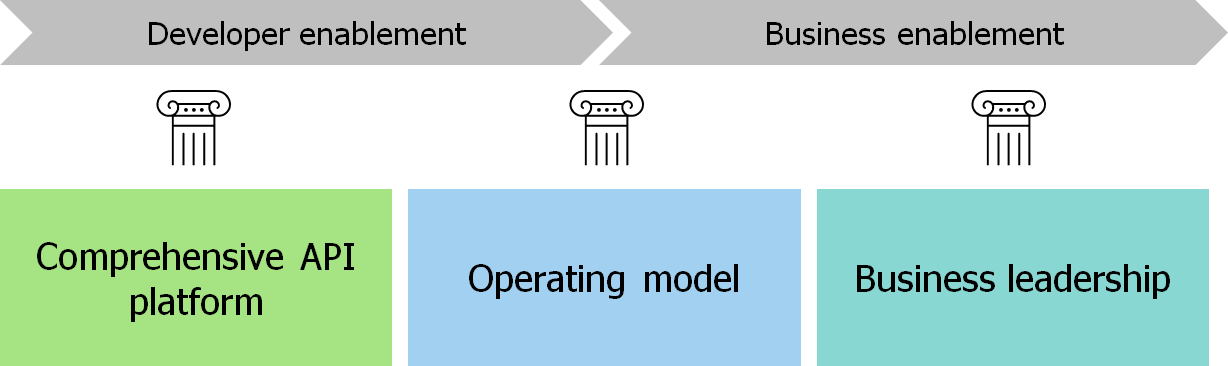
In my work with clients, this pillar consistently separates API programs that stall from those that scale. As agentic AI matures, it becomes even more important. Forrester clients who need to explore this pillar more deeply can read my new report, Forrester’s Three-Pillar API Enablement Model: Establishing Business Leadership, or schedule a guidance session with me.