“Why Won’t Sales Pay Attention To Me?” — Four Hacks To Reduce Enablement Anxiety
One of our most common revenue enablement customer requests equates to the blog title. It’s often delivered under the guise of “enabling our sellers to succeed” when initiatives are well designed or “we need to land this on sales” when they aren’t. Typically, this means marketing and operational leaders asking to reduce their own frustration at being ignored by sales teams. The most egregious requests include the word “make,” as in “Can you help me make salespeople … ” adopt, say, send, or do the bidding of non-sales counterparts. Seriously, when was the last time anyone influenced a quota-carrier to do anything they didn’t want to do?
This “ignoring us” issue arises when enablement efforts are not explicitly created and executed to serve sellers’ best interests but to satisfy production or activity goals from other functions. Examples include the following:
- Product marketing puts significant resources into a major launch and needs to train sales on it.
- Field marketing develops a new demand campaign and needs sales to adopt and convey the new messaging.
- Customer advocacy finalized a new suite of testimonials and needs sales to lead new-logo acquisition with case study validation.
Each statement represents valid business goals but is articulated through the needs of non-sales functions — hence the difficulty in gaining reps’ attention, because there’s no “What’s in it for me?” (WIIFM) or representation of customer-centric, outside-in design. Fortunately, Forrester has you covered. If you can positively progress through these four steps, your days of sales irrelevance will soon end:
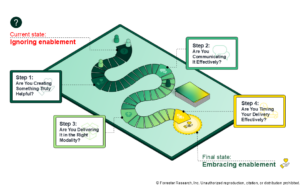
1. Are You Creating Something Truly Helpful?
Daily, we see amazing examples of revenue enablement that sellers should seemingly love and, unfortunately, do not take as kindly to. No doubt, everyone authentically wants to enable sales — all paychecks improve when sales succeeds — but “they’re gonna love this!” is a sentiment too often generated through wishful thinking. View sales as an internal customer and follow the same rigor with which your external campaigns are delivered.
Helpfulness humility check: As simple as this sounds, validate whether your enablement matters to sales. Leverage first-line managers, sales advisory councils, and enablement help desks to gain objective feedback on your project. Be willing to accept rejection, because failure is an amazing teacher. If, however, sales reacts positively, proceed to step two.
2. Are You Communicating Effectively?
Effective sales communications is straightforward when managed correctly. It involves solving for three basic questions that you should anticipate sales asking: 1) “Why are we doing this?”; 2) “What does it mean for me?”; and 3) “What do you want me to do?” The simplicity of this formula is if each of your three answers doesn’t translate into “We’re going to get you to Winner’s Circle faster,” stop enabling, because you’re actually “inflicting” and amplifying why they ignore you. Instead, communicate with sales as a buyer: Earn the call to action through pure WIIFM.
Communications humility check: You likely analyze external campaigns to improve stickiness, but do your sales communications contain the same rigor? Turn the analysis of audience engagement into a continuous learning and improvement discipline, applied internally. Your consumption will improve, allowing your progression to step three.
3. Are You Delivering It In The Right Modality?
Forrester research is consistent regarding how your best sellers want to learn: through peer interactions, role-play, manager assistance, and on-the-job, interactive modalities. Yet we constantly see the lowest-ranked formats deployed in the wild — mandatory live webinars, reading assignments, podcasts, and (shiver) gamification — because folks think it will work, or because it’s easy, or it’s how they’ve always done it, or a vendor impressed them. Wouldn’t it be better to know what will be effective?
Delivery humility check: This one is so easy: Ask your learners! Solicit quantitative and qualitative feedback on your training and other enablement activities. Chances are you’ll discover that your best reps learn by doing, not by listening, reading, or watching. Then you’ll have only one more step …
4. Are You Timing Your Delivery Effectively?
Plenty of enablement plans succeed with the first three steps and then fail because field delivery timing is dictated by the convenience of the creators, not the context of sellers. Remember the golden rule that your reps only care about one thing: their current deals, opportunities, renewals, and relationships. If your enablement doesn’t 100% support this 24/7 laser focus, you lose.
Timing humility check: One of our most popular research topics is activity-based revenue enablement. Arm reps and managers with what they need to achieve their goals (not yours) in the moment, space, and pane of glass they use to meet and beat quota. This is a perfect fit for today’s AI applications.
So when will you adapt your approach to this model? If you need help with enablement relevance, Forrester customers have unlimited access to our analysts and resources. Ask for a guidance session here.
Categories