Machines Are Your Content’s New Audience
The New ABCs Of Marketing Help Define The Future Of Content
Content creation is ground zero for the seismic impact of AI innovation. That’s a big shift. For decades, organizations have created content around a fundamental assumption: Content is created by humans, for humans. Now, humans are already working with machines to cocreate virtually every content format, manage the content lifecycle, and optimize media.
As AI accelerates and agentic systems begin to orchestrate more digital journeys, machines are simultaneously content creators and a primary content consumption audience. How so? Because these machines increasingly decide which content buyers see, especially on answer engines. Enter the new ABCs of marketing: Business-to-Agent now joins Business-to-Business and Business-to-Consumer to form the future of content creation and consumption.
Today’s Content Still Misses The Mark — And AI Alone Can’t Fix It
Even with massive investment in genAI, most businesses remain stuck in legacy content processes and tech. The biggest culprit: Content creation still depends upon fragmented content repositories with siloed data and manual processes. Not surprisingly, even though four out of five B2B organizations are adopting or implementing genAI for content use cases and just over half of B2C and advertising decision-makers expect to invest in more user-generated and influencer content, digital leaders tell us that the impact on business outcomes remains elusive.
AI features in CMS and DAM solutions cannot solve core operational challenges and disjointed workflows. And generated content exacerbates the potential for misinformation, brand inconsistency, privacy breaches, and compliance failures. Add to this situation that more content is generated at machine speed, resulting in more wasted content; that’s inexcusable, as it drives higher cloud storage costs in addition to usage-based pricing for AI features.
The Result
Consumers and buyers are overwhelmed with irrelevant content because the systems that drive digital experiences make increasingly opaque decisions about which content to surface, but today’s dire state isn’t irreparable.
Introducing Intelligent Content
Done well, we define content that achieves engagement goals by combining human creativity, AI, and data to self-optimize dynamic experiences by learning, understanding, and adapting to real-time behavior as “intelligent content.” Let’s unpack why that matters.
For organizations, intelligent content represents a shift from creating more content to creating smarter content. It reduces waste, improves relevance, and enables outcomes that static content can never achieve. Intelligent content is:
- Dynamic. It adapts in the moment based on signals from buyers, contexts, systems, and agents. This isn’t personalization as we know it — it’s continuous real-time optimization to achieve audience objectives.
- Generated with existing content technology and agentic AI. Existing content and digital asset management technology is the foundation for abstracted content models, knowledge graphs, and agentic layers that activate intelligent content.
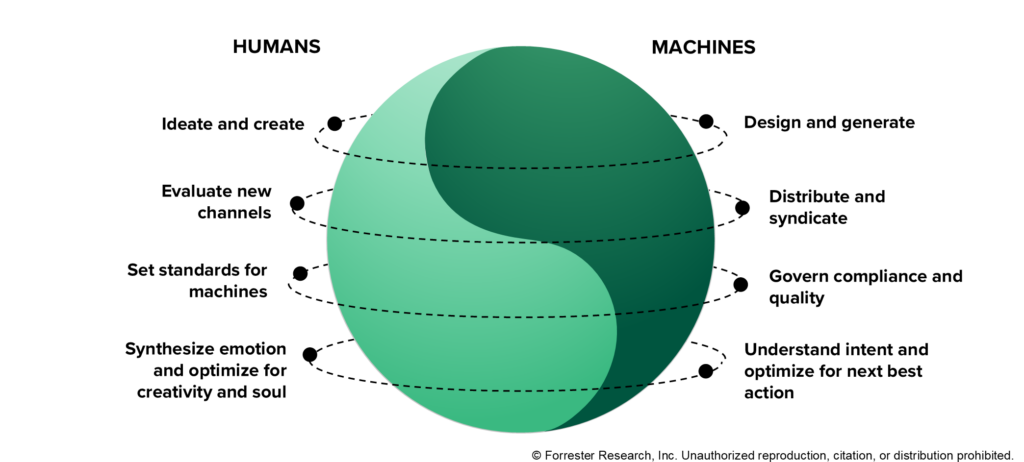
- Cocreated by humans and machines. Humans don’t disappear in intelligent content creation. Rather, they ideate, strategize, and create governance guardrails. Machines design, generate, and optimize at scale. This human-machine content creation partnership reshapes roles across design, editorial, operations, and analytics.
Embrace A New Digital Operating Model With B2A In The Mix
Organizations that continue creating content only for humans — and not also for machines — will increasingly lose visibility, relevance, and performance in digital experiences that AI mediates. Those that build agentic content systems — grounded in structure, governance, modularity, and human-machine collaboration — will set the standard for the next era of engagement. Here’s where to start:
- Build for both audiences — humans and machines. Create content for humans that drives emotions. Structure content so machines understand meaning, relationships, and context.
- Develop guardrails for agentic content generation. Treat AI agents as active participants in your operating model. Define accuracy, tone, compliance, and engagement requirements. These guardrails give agents clear instructions and human oversight.
- Design a new human and machine operating model. Designers and creators will increasingly define pattern libraries, not finished assets. What this means: Machines will be able to dynamically generate consistent, on-brand content variants. This human and machine partnership tees up humans to lead a new era of digital content operations.
If you are a Forrester client interested in discussing the evolution of your content, book an inquiry or guidance session with us. We are available to discuss topics such as content strategy, agentic content systems, content operations, content intelligence, creative and production development, and service provider selection. Our forthcoming research on content strategy, content intelligence, and content operations can help your organization pragmatically lean into content in the age of AI.
Related Forrester Content