The Biggest Surprise From The New Revenue Enablement Platforms Wave Isn’t AI
Today, Forrester published The Forrester Wave™: Revenue Enablement Platforms, Q4 2026. In assessing Allego, Highspot (pre-merger), Letter AI, Mediafly, Mindtickle, Pitcher, SalesHood, Seismic, and Showpad, we executed on the rigorous standard evaluation of detailed questionnaires, strategy briefings, product demonstrations, comparative scoring, and interviews with 22 vendor customers.
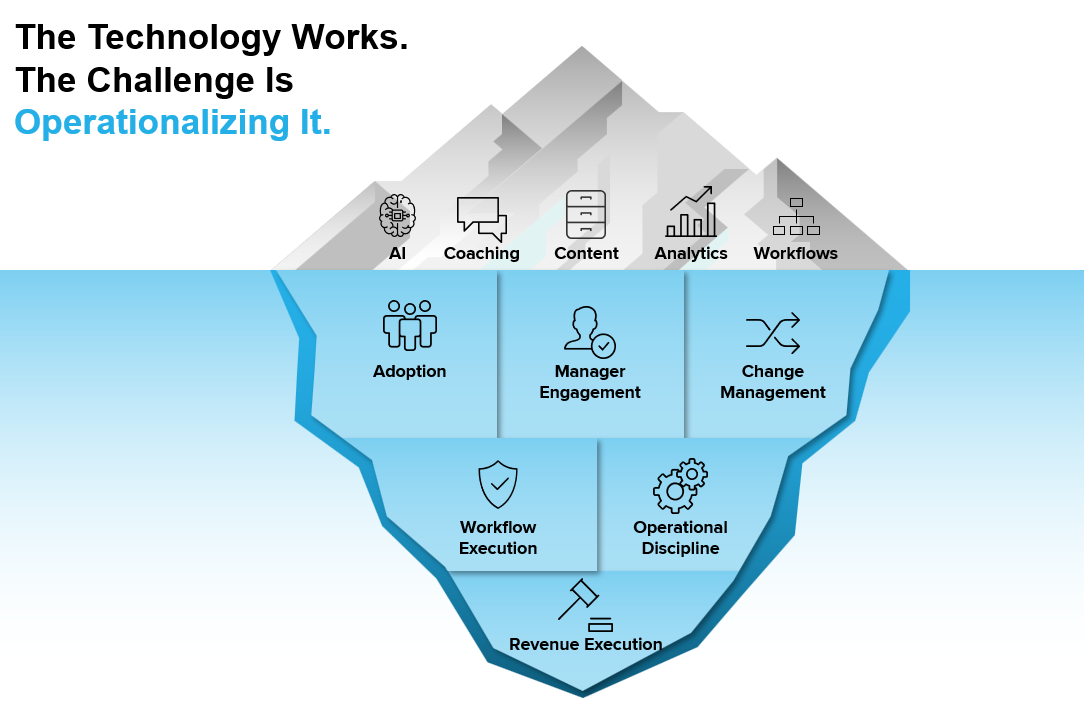
We expected to see impressive AI, and we did. The platforms demonstrated AI role play, conversation scoring, content generation, seller assistants, deal guidance, multilingual experiences, manager insights, and increasingly sophisticated agents. The progress this industry has made is remarkable. But the biggest surprise was how much of the platform’s capability their customers have yet to operationalize.
Revenue Enablement Technology Works
Let’s begin with the good news. Customers overwhelmingly told us that their revenue enablement platforms (REPs) deliver what vendors promised, perform in real workflows as presented during the buying process, and improve seller readiness and execution. Most customers realized measurable value within several months, with many reporting positive results within 60 days.
REPs have progressed far beyond their origins as content repositories and learning destinations. The most advanced platforms can connect content, learning, coaching, competency development, buyer engagement, conversation intelligence, and opportunity data to help sellers and managers execute more effectively. These platforms are increasingly capable of becoming systems of sales execution. But most customers still operate them as incomplete collections of content, learning, coaching, and productivity tools.
Five Hard Truths About REP Success
Our customer interviews exposed realities that every current and prospective REP customer should confront:
- Most organizations use only part of what they buy
Customers reported using approximately 75% of their available platform capabilities, and remember, this was a carefully curated set of reference customers. Some deliberately phase their deployments, but unused functionality still represents unrealized value. The recurring message around under-utilization was “we’ve not gotten there yet.” Change management, competing priorities, limited administrative resources, and organizational readiness prevent many companies from taking advantage of workflows, automation, coaching, analytics, and AI capabilities they already own.
- The biggest barriers are managerial and organizational
Frontline manager adoption received the lowest adoption rating among the stakeholder groups we examined. That matters because managers determine whether insights become coaching, whether new behaviors receive reinforcement, and whether the platform becomes part of deal reviews, coaching 1-1’s, and performance conversations.
As one customer told us, “Manager behavior determines whether the platform becomes transformational or just useful.” To drive broader adoption, give managers a compelling reason to adopt the REP themselves.
- Connected applications do not guarantee connected execution
CRM integration is nearly universal among the customers we interviewed, but CRM-driven enablement is not. Data can move successfully between systems without changing what a seller sees, what a manager prioritizes, or which coaching intervention occurs. Integration should be measured by whether the connection improves a decision, action, workflow, or business outcome. The integration is finished when the data improves teamwide execution.
- REPs measure better than they mobilize
This may be the most important finding. Customers rated their ability to measure enablement, guide decisions, and communicate value more highly than their ability to target and automate enablement actions. Many deployments remain pull-based: users recognize a need, seek assistance, interpret the response, and decide what to do.
More mature, push-based enablement observes relevant signals, diagnoses the need, selects an intervention, delivers guidance in the workflow, activates human judgment, and measures what changes. A dashboard identifies an opportunity; an execution system mobilizes the response.
- AI Amplifies Maturity.
Most interviewees are using AI for role play, simulations, coaching, and content generation. But AI scales what the organization gives it, including its operating-model weaknesses. Before buying more AI, determine whether your organization can operationalize the capabilities it already owns.
What Should You Do Next?
Read the new Wave, but don’t stop at the graphic. Use our online evaluation tool to ask better questions about your own technology journey. Forrester clients can schedule time with me if you are:
- Deciding whether you need a REP.
- Relying on an HR LMS, SharePoint, a DAM, or homegrown alternatives.
- Building requirements or evaluating vendors.
- Dissatisfied with your incumbent platform.
- Struggling with adoption or manager participation.
- Unable to demonstrate ROI or communicate enablement value to leadership.
- Trying to operationalize AI and activity-based enablement.
- Ready to move from revenue enablement toward completed teamwide execution.
Non-clients can purchase the report or explore how a Forrester relationship can support technology selection, implementation, adoption, and value realization. And coming very soon: A Buyer’s Guide to Revenue Enablement Platforms, 2027. It will explore why satisfied customers still underutilize their platforms and what buyers can do differently.
The technology is ready. The next competitive advantage belongs to organizations that are ready to use it.