Trust: The Hard Currency Of B2B Partner Ecosystem Success
With the continued rise in the importance of partner ecosystems, many B2B organizations increasingly rely on partners for a significant portion of revenue, customer reach, and innovation. Business leaders don’t always fully appreciate that cultivating trust among partners is necessary for winning business, sustaining long-term relationships, and building a strong brand. In B2B relationships, trust isn’t optional; it’s the hard currency that drives growth. Trusted companies win and retain customers, earn peer recognition, and enjoy strong buyer preference. For business buyers, trust often determines purchase intent. For partner ecosystems, establishing trust fuels partner loyalty.
Forrester’s B2B research confirms trust as a key driver of success. Buyers who trust a company are nearly twice as likely to recommend it or pay a premium compared to those who don’t. Clearly, trust drives tangible business outcomes. But what is trust, and how can organizations build it?
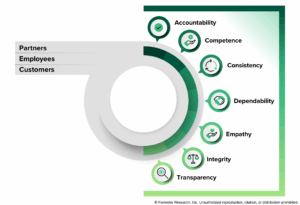
The Seven Levers Of Trust
Forrester identifies seven dimensions of trust: accountability, competence, consistency, dependability, empathy, integrity, and transparency. These levers turn trust from an abstract ideal into a measurable strategy. Not all levers carry equal weight, however. Our research finds that buyers prioritize competence, consistency, and dependability above all others — let’s look into why these dimensions matter most.
Competence: Expertise That Inspires Confidence
Competence is foundational. Buyers evaluate providers, including their partners, based on perceived expertise, which shapes expectations for successful outcomes. In complex or regulated markets, domain knowledge is critical. Certifications and accreditations signal credibility, showing that a partner meets rigorous standards.
Forrester’s Buyers’ Journey Survey, 2025, reinforces this: Domain expertise, industry expertise, and technology expertise rank among top purchase drivers. Organizations that showcase competence through thought leadership and proven results with partners position themselves as trusted advisors.
Consistency: Reliability Over Time
Consistency reassures buyers that promises will be kept repeatedly. It enables effective planning and reduces uncertainty. Suppliers must invest in processes and tools that guarantee a uniform experience across touchpoints. Partners should extend this reliability into new markets or accounts, ensuring scalability without sacrificing quality.
Consistency isn’t static; it requires continuous improvement. Organizations that deliver predictable outcomes while adapting to evolving needs earn lasting trust.
Dependability: Following Through When It Counts
Dependability is trust in action. Buyers expect providers, and their partners, to honor commitments, even under challenging circumstances. A dependable supplier minimizes risk, offering confidence that deadlines will be met and quality maintained. This reputation often cascades through the ecosystem: Trusted suppliers elevate their partners, while trusted partners endorse suppliers by association.
Trust Transference: The Hidden Accelerator
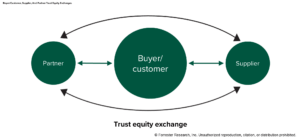
Trust flows through networks. The concept of transferable trust involves leveraging existing trust to build new connections through a “trust equity exchange.” Two common scenarios illustrate this:
- Supplier → Partner. A supplier with strong brand reputation can extend trust to its partners. Buyers perceive these partners as more credible because of their association with the trusted supplier.
- Partner → Supplier. Conversely, a partner acting as a trusted advisor can influence buyers to choose a supplier’s offerings. Here, the partner’s established relationship becomes a bridge, accelerating the supplier’s market penetration and revenue growth.
These exchanges highlight why trust-building must extend beyond direct buyer interactions. Suppliers and partners should collaborate strategically to amplify trust across the ecosystem.
The Compounding Effect Of Trust
Trust behaves like compound interest: The more you invest, the greater the returns. Organizations that prioritize trust show higher engagement, loyalty, and advocacy. Buyers and partners are more likely to renew contracts, explore new offerings, and recommend your brand.
To harness this effect, suppliers must think holistically. Building strong partner programs that enable trust exchanges ensures that buyers feel confident in the entire value network.
The bottom line for B2B partner ecosystems is that trust shouldn’t be an afterthought — it’s strategic. Suppliers that treat trust as a hard currency will outperform competitors and unlock exponential growth.
Forrester clients can download the latest research report, Trust Is A Hard Currency That Suppliers And Partners Must Leverage Now, for a deeper dive into how B2B organizations can navigate trust across B2B partner ecosystems or schedule a guidance session with Maria Chien.