Conversational Banking Won’t Scale Without Strong Foundations
For years, banks have invested in chatbots, virtual assistants, and, more recently, generative AI-powered experiences. Most efforts have focused on specific tasks: answering questions, supporting transactions, or automating service interactions. But as conversational banking evolves beyond a channel capability and into an enterprise capability, a more fundamental question emerges:
Can your bank scale conversational banking safely, consistently, and responsibly?
That’s the focus of my latest report, Prepare The Foundations For Conversational Banking. This report explores the data, architectural, governance, and operating model capabilities required to move from experimentation to enterprise-scale deployment.
The Next Challenge Isn’t The Interface — It’s The Operating Environment
Most banks no longer need convincing that conversational banking matters. Instead, they are grappling with how to expand beyond isolated pilots and disconnected deployments.
This challenge stems from a fundamental shift in what conversational systems do. They are no longer limited to answering questions; increasingly, they interpret customer intent, orchestrate decisions, apply policies, and execute actions across journeys. As a result, weaknesses in data, architecture, or governance can affect not only customer experience but also customer outcomes, operational resilience, and regulatory compliance.
In our previous report, Create Your Conversational Banking Roadmap, we argued that banks need a clear vision, strategy, and roadmap anchored in customer trust and outcomes. Conversational banking should not be pursued as a cost-reduction exercise alone. It must help customers achieve meaningful outcomes while reinforcing trust.
But strategy alone is not enough. Banks cannot scale conversational banking if customer data remains fragmented, governance is inconsistent, or architectures cannot support secure execution across systems. That’s why the next stage of maturity requires banks to focus on foundations.
Three Foundations For Enterprise-Scale Conversational Banking
Our research highlights three interconnected areas that banks must strengthen to support conversational banking at scale.
Data And Knowledge Foundations
Conversational systems depend on access to accurate, contextual, and well-governed data and knowledge.
While banks possess vast amounts of customer and operational data, these assets often remain fragmented across products, channels, and business units. The result is inconsistent experiences, limited context, and greater risk when AI systems operate across journeys. Leading banks are investing in:
- Data quality, lineage, and semantic governance.
- Unified customer context and customer 360 capabilities.
- Curated enterprise knowledge repositories.
- Secure execution layers that connect intent to authorized action.
Without these capabilities, even sophisticated conversational interfaces struggle to deliver reliable outcomes.
Secure Architecture And Decision Orchestration
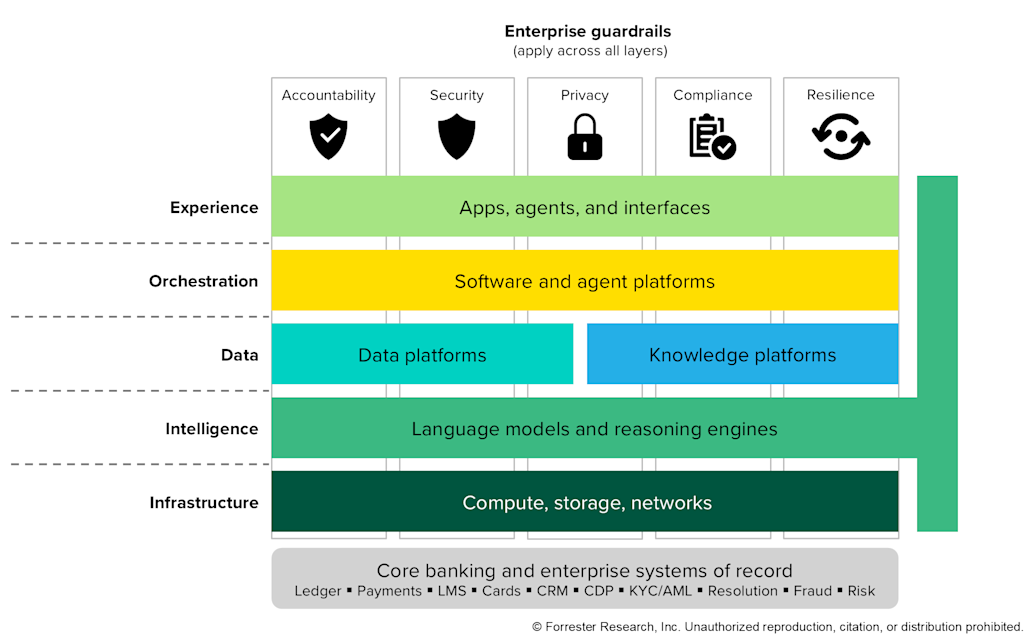
The future of conversational banking depends on orchestration. Banks need architectures that connect models, policies, enterprise systems, and human oversight in a controlled and repeatable way. Rather than operating as standalone applications, conversational experiences increasingly act as coordination layers across customer journeys. Key capabilities include:
- Omnichannel context continuity.
- Hybrid architectures that combine deterministic and generative approaches.
- Runtime governance and interaction memory.
- Modular, vendor-agnostic technology stacks.
- Risk-aligned decision orchestration.
Governance And Operating Models
Perhaps the most important finding from our research is that conversational banking should be managed as an enterprise capability rather than a technology project. As conversational systems become more autonomous, governance must be embedded from the outset. Accountability, risk management, compliance, and performance oversight need to be integrated throughout the lifecycle. Key elements include:
- Enterprise control planes and oversight mechanisms.
- Risk-based escalation and intervention processes.
- Continuous monitoring and model validation.
- Federated operating models that balance central governance with business ownership.
- Workforce readiness and operating model evolution.
From Roadmap To Reality
This report completes a three-part research series on conversational banking at a time when the industry is shifting from AI experimentation to execution.
Our first report explored the evolution of conversational banking and emerging market dynamics. The second helped banks develop outcome-led, trust-based roadmaps focused on customer outcomes, trust, prioritization, measurement, and governance. This latest report addresses the next stage of maturity: As banks explore conversational systems that can increasingly reason, decide, and act across customer journeys, strong foundations become a competitive necessity. Read the report to understand what it takes to move from conversational AI experimentation to secure, enterprise-scale conversational banking. Banks that invest now will be better positioned to deliver intelligent, outcome-oriented banking experiences while maintaining trust, control, and regulatory confidence.
Forrester clients can schedule an inquiry or guidance session with me to discuss the findings and their implications for their own conversational banking strategy.
Related Forrester Content