Hannover Messe 2026: Do Robots Need Tea Breaks?
Another year, another trip to Germany for April’s Hannover Messe industrial trade fair. At just 110,000, the visitor count was 85% of last year’s, at least partly due to the situation in the Middle East making it difficult to travel from or through regional hubs like Abu Dhabi and Dubai. A two-day transport strike in Hannover also didn’t help, but it did provide my first surreal experience of a train being “too heavy” to leave the station: The police eventually showed up to cajole enough people off the train so that it could finally start moving.
Lazy Robots Were Everywhere I Looked
Before making this year’s trip to Hannover, I predicted that I would see a lot of robots. It was an easy prediction to make and — of course — it was true. I was also right to predict that “most of them will be Chinese.” Again, that wasn’t a difficult prediction to make. What I didn’t predict was what all these robots would be doing all week. The answer, in the majority of cases? Almost nothing. From my point of view:
- Some were incapable of movement. They were props, fixed in place like mannequins in a department store window. Around almost every corner, unmoving — and useless — humanoid robots waited to disappoint the unsuspecting visitor.
- Some moved, pointlessly. Yes, Unitree’s humanoids were dancing as usual. It’s unclear why breakdancing is a core skill for a potential worker in a warehouse or factory, but robot makers do love to have their robots bopping away. At least whoever ran the Unitree stand recognized that robots in motion are more interesting than robots at rest: Almost every time I walked past, at least one of their robots was enthusiastically jigging to a tune only it could hear.
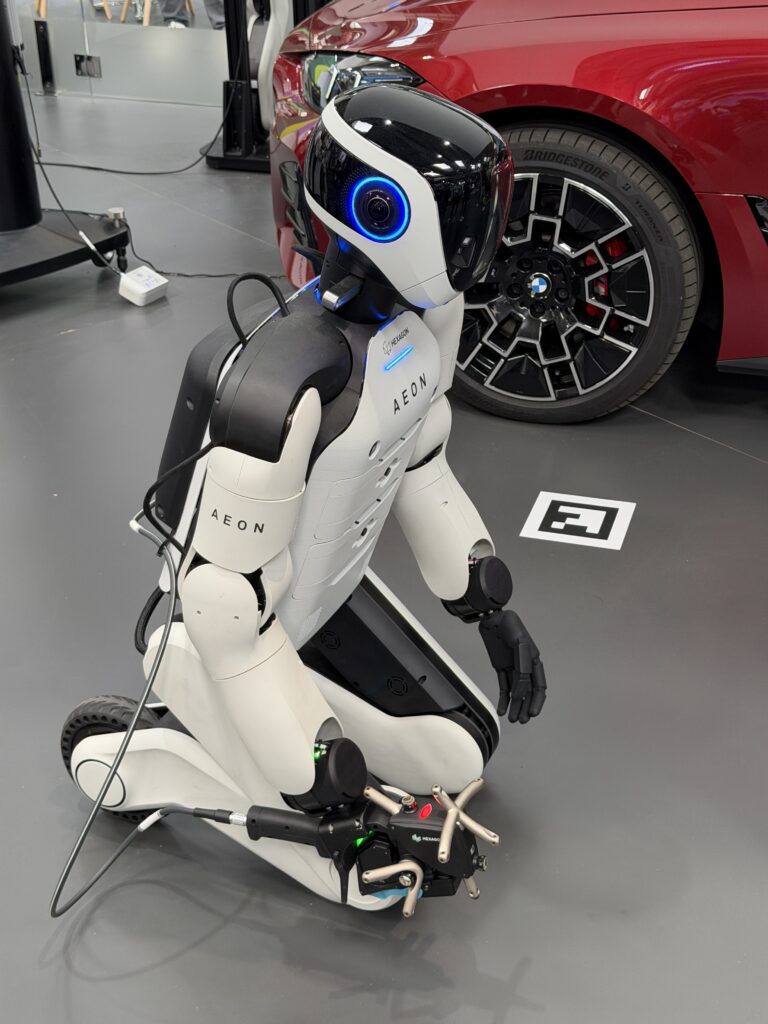
- Some did useful things, sometimes. Not all of the movement was pointless, of course. At various times during the show, robots woke from their slumber to show what they’re capable of: For example, Humanoid’s HMND carried totes around the Siemens booth, Hexagon’s AEON scanned a BMW, and Agile Robots’ Agile ONE sorted widgets into boxes. Once the short demonstrations finished, they returned to sleep. While I wasn’t recording a time-and-motion study with my stopwatch, these robots definitely spent far more time resting (or being tinkered with by their minders) than working. For passing visitors, the chance of seeing a robot move with purpose was far smaller than the chance of seeing it on the robotic equivalent of a tea break.
- AEON gets my award for resting neatly. While most of their competitors’ idle robots hung disturbingly from safety harnesses like carcasses in an abattoir, or slumped untidily in a chair or on the floor like a sack of potatoes, Hexagon’s AEON had the good manners to kneel gracefully.
AI Gets Physical
I had just published a new report, Physical AI Perceives, Reasons, And Acts In The Real World, which I was excited to discuss with anyone who would listen; despite my predisposition toward any mention of “physical AI,” however, I really didn’t need to try hard to find it. Everyone seemed keen to talk about their company’s vision of a world in which AI-augmented tools gain some ability to perceive, reason about, and act upon that world. Flexible, adaptive, and multipurpose robots are one obvious embodiment of these capabilities, but they also crop up in energy grids, software-defined factory cells, and more. The sooner the robots move into the background, and we focus more attention on the systems and workflows of which they are just one small part, the sooner we’ll all start seeing tangible benefits at scale.
AI Is 42, And That’s A Problem
As any reader of Douglas Adams’ The Hitchhiker’s Guide To The Galaxy knows, “42” is the answer to life, the universe, and everything. The problem, he pointed out, is figuring out the question. AI feels a bit like that right now. Want to improve productivity? AI. Need to reduce your energy bill? AI. Keen to cut unplanned downtime? AI. Hoping to shift production from economies of scale to economies of scope? AI. Excited to make angels dance on the head of a pin? AI, probably. AI has a role to play in all of these and more, but it’s not the same AI, it doesn’t use the same data, and it’s not deployed in the same way. It’s easy to say “AI” every time anyone asks you anything — it’s far harder to actually make it work dependably, explainably, repeatably, and at scale. To the superficial observer wandering Hannover’s halls, the pushers of AI are clearly on to something. For everyone else, there’s a multitude of unanswered questions … and a nagging doubt that the pushers of AI may be on something.
Some Hints At Scale
In among the hype and the noise, there were some interesting pointers toward genuinely useful solutions with the ability to scale:
- Siemens’ Eigen Engineering Agent evolves beyond copilots. Siemens did something interesting with its first Industrial Copilot, launched back in 2023. It was an early example of an idea that’s since become widespread: offering a chat interface that front-line workers can use to query product documentation, operational insights from working machines, and more. Siemens went on to launch further copilots that met specific customer needs but began to risk confusing everyone as they proliferated and overlapped. The Eigen Engineering Agent is a bit of a reset, with a new name and a new set of capabilities. As Siemens’ press release notes, “Unlike … copilots that merely generate advice, the Eigen Engineering Agent [begins to operate] within real engineering systems to plan, execute, and validate tasks, end to end.” Let’s hope that the landscape of copilots and agents will be more clearly mapped and explained as further agents join Eigen in the toolkit.
- Kongsberg Digital wins a prize with Yara. Kongsberg Digital’s digital twin solution, the Industrial Work Surface, has been deployed at one of fertilizer and industrial chemical company Yara’s largest production sites, Yara Porsgrunn. Microsoft awarded the companies a Microsoft Intelligent Manufacturing Award for the successfully scaled deployment, which runs on Microsoft’s cloud.
- Schaeffler makes a (non-exclusive) bet on Hexagon. Schaeffler has been one of the more enthusiastic testers of various robotic form factors in recent years. The company also makes the actuators that help robots move and has a vested interest in a healthy robotics industry. Following a pilot deployment, Schaeffler announced its intention to deploy “at least 1,000” of Hexagon’s AEON humanoid robots over the next seven years. It’s a statement of intent rather than a water-tight contract but still a very different beast from today’s more typical deployment of a handful of robots in tightly controlled test conditions.
- Tulip Factory Playback pulls pieces together. I’ve seen several of NVIDIA’s “desktop supercomputers” since they were first launched, but most of them have actually been empty golden boxes. I saw one in Hannover, too, and assumed it was another empty box — it wasn’t. It really was a DGX Spark, and it really was running Tulip’s new Factory Playback offering: edge processing, multiple cameras, a vision language model to check the AI box, and meaningful integration with the manufacturing execution system and other tools, all doing useful things that are illustrated in the video on this page. It’s impressive and interesting, but I look forward to seeing how customers actually deploy it and what tangible benefits they can realize.
- Autodesk Tandem grows up. During a wide-ranging conversation with Autodesk’s Jan Niestrath, he mentioned some of the ways the company’s Tandem digital twin tool is now being used. It’s a while since I’ve looked seriously at Tandem, and the team at Autodesk’s Birmingham Technology Center really does seem to be putting the product through its paces. Time to take another look at the way this supports Autodesk’s vision to help customers design, make, and run.
- Amazon Web Services (AWS) does robots. Of course it does. If you’ve been reading from the top, you’ll know that everybody does robots now. The company shouted about its partnership with one of Germany’s big humanoid robot hopes, NEURA, but I was actually more interested in all the things the AWS team had to tell me about supporting Amazon’s own robotics work. Talk about scale.
- USD becomes glue. Universal Scene Description (USD) started life at Pixar over a decade ago, supporting the graphics pipeline behind the company’s animated films. More recently, the Alliance for OpenUSD (members include the likes of Autodesk and NVIDIA) has worked to extend and promote the format and its tools. Interestingly, several firms at Hannover talked about USD as key to chaining together different systems and workflows to support their digital-twin-like projects. Microsoft’s use case with Krones’ bottling lines apparently uses USD as a data transfer format to move models between Ansys and other systems in the pipeline, simulating spilling and sloshing (a technical term, I promise) as different bottle shapes rapidly fill with liquid.
- Siemens’ Industrial Foundation Model builds toward critical mass, with a little help from their friends. Siemens made a lot of noise about its Industrial Foundation Model (IFM) at last year’s Hannover Messe and at the company’s own AI with Purpose Summit in Munich last May. IFM was barely mentioned this year, but that’s probably not a bad thing: Even a company of Siemens’ scale can’t build this themselves, and they’re actively collaborating with a growing set of industrial partners to deliver something that should meet a real need. Fascinating questions around who pays — and when — aren’t all worked out yet, of course.
- More companies recognize they can’t do it alone. This has been a recurring theme in my coverage of Hannover Messe over the years. Success in this space requires partnership. Siemens’ IFM will only succeed if partners engage. On the Microsoft booth, the company made a point of highlighting all of the stakeholders involved in assembling its working demos. The Hexagon AEON robot assembling Schaeffler components, for example, was simply the visible front to a gaggle of more than half a dozen high-profile partners, each of which had its logo displayed alongside the assembly cell.
What About 2027?
Hannover Messe loses a day next year, with the Friday I’ve never bothered to attend disappearing from the program. The event also moves earlier (April 5–8), once again getting worryingly close to the birthday it co-opted in 2025. Hotels will still be obscenely expensive, but at least we might see more cherry blossoms than what was left on the trees this year.
Back in 2019, a lot of the talk was about whether (or not) manufacturers’ data might move to the cloud: The public cloud hyperscalers were making their case loudly, with huge and expensive booths. 2022’s big theme was sustainability. 2023 saw everyone trying to work out what their ChatGPT and metaverse stories could be. 2024 was the year I wrote, “Everyone had an AI story, even if few made much sense,” and 2025 saw AI boosterism reach new heights. 2026 felt like a bit of a bridging year as vendors continued to slip “AI” into every sentence but then had the self-awareness to look vaguely embarrassed to be doing it. They and their prospective customers know that something more is needed.
So what am I hoping for in 2027? Pragmatic, practical, and scalable technologies, judiciously augmented by AI when that makes sense, which I can credibly recommend that a client deploy rather than just play with — please, if it’s OK with the rest of you, and leave the mannequins and dance moves at home.
As always, if you have your own perspectives to share, please schedule a briefing and tell me all about them. If you’re a Forrester client and want to discuss (or challenge) my thinking on these topics, schedule an inquiry or guidance session.
Categories