In An AI World, High-Performance IT Is Mandatory For Business Success
Technology leaders are operating in an environment defined by constant and accelerating disruption. AI adoption, geopolitical volatility, mounting technical debt, and unrelenting cost pressure demand that IT steps up for its business partners. Simultaneously, the tolerance of IT and CIO failures is waning as quickly, forcing a vision and strategy that goes beyond incremental improvement or isolated modernization efforts. CIOs must have a clear and scalable method to focus their investments, earn business confidence, and deliver quantifiable positive business outcomes. That is the role of high-performance IT (HPIT).
Forrester defines HPIT as: “the pursuit of continuously improving business results through technology. It represents a strategic approach where IT organizations align closely with business objectives, build trust through reliable execution, and adapt rapidly to changing market conditions.”
HPIT isn’t about maturity for its own sake — that’s a flawed mentality and losing approach. HPIT is a business-aligned journey with purpose, intent, and measurable value realization. Long-term success comes from a trusted bond between IT and business that’s driven by proficiency in foundational IT capabilities.
Two forces determine whether IT reaches this high-performance state: the strength of its core technology capabilities and the level of confidence that business leaders have in IT’s ability to deliver what matters, when it matters. When these forces are aligned, IT becomes a growth partner — when they diverge, IT becomes constrained, disconnected, or trapped in constant crisis mode.
Business Confidence Matters As Much — If Not More — Than Technical Capability
The assumption might be that stronger platforms, better talent, and modern delivery practices will guarantee credibility with the business; in practice, however, the opposite is often true. Business confidence is what unlocks sustained investment and permission to change course when conditions shift, which is all the time. Even highly capable IT organizations struggle to move beyond incremental wins without the internalization of three HPIT guiding principles:
- Alignment. Ensure that IT focuses on what truly matters to business operations. When technology investments must be explicitly tied to business outcomes, priorities stabilize and trade-offs are clearer. Only then can IT have a seat at the table and be viewed as part of the leadership team rather than a cost center. If you treat alignment as a continuous discipline — not an annual planning exercise — you avoid fragmented roadmaps and constant reprioritization.
- Trust. Build trust through demonstrated reliability, risk discipline, and transparency. Strong security, privacy, and resilience practices are necessary but not sufficient on their own. What matters is whether your business partner believes you’ll deliver what you promised and manage the risk responsibly while doing so. Repeatable, predictable, and on-budget execution builds trust; regular outages, degradations of services, and technical debt destroy it.
- Adaptivity. Keep pace with change, no matter what happens. Anticipation of and preparation for the next hurdle or vital unexpected decision is emblematic of an HPIT organization. Adaptivity is a leadership skill that enables you to reallocate capital and capacity quickly and as needed to address changes in technology health and shifting market demands.
Matching IT Capabilities To What The Business Needs Now
Technical proficiency doesn’t look the same in every organization for every IT capability. Your business partners’ challenges aren’t the same as someone else’s, so your proficiencies don’t need to mirror another organization’s IT capabilities. HPIT means building the right mix of capabilities to deliver the portfolio that your business requires today while anticipating tomorrow’s shifts. Your journey will be propelled forward by four styles that constantly adjust to inform technology investments and align IT spending with business objectives. When the composition doesn’t match business priorities, IT performance stalls and business confidence erodes. IT organizations should:
- Provide enabling capabilities to provide strong foundations. They stabilize, secure, and modernize the environment so the business can operate with confidence. When enabling is weak, everything else slows down or fails.
- Utilize cocreating capabilities to deliver product-led growth. These capabilities allow IT and the business to build new digital products together, ship quickly, and respond directly to customer needs. They’re essential when growth depends on technology.
- Amplify capabilities to drive scale. Automation, analytics, and AI are used to increase output without increasing cost, augmenting human judgment rather than replacing it. These capabilities matter most when efficiency and consistency are strategic priorities.
- Transform capabilities to reimagine business models. Here, IT helps the business explore new markets, new revenue models, and new ways of creating value, often ahead of explicit demand.
Use The HPIT Compass To Guide Your Journey
The HPIT Compass brings business confidence and IT capabilities together into a single view. Your position on the compass isn’t a declaration of success or failure — it’s merely the identification of what leadership’s attention must focus on first and the trajectory of your journey to HPIT.
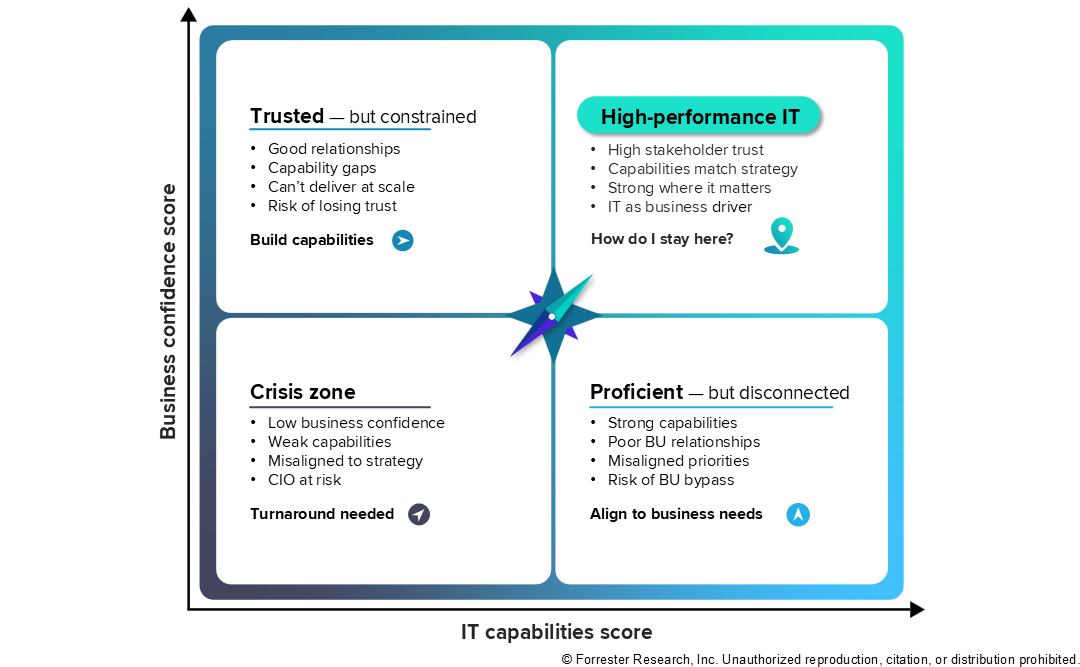
Organizations with high confidence but weak capabilities must invest quickly in the right IT capabilities before trust runs out. Those with strong capabilities but low confidence must change how they communicate and demonstrate value in what they deliver. Organizations weak on both axes face a burning platform and are in the crisis zone. They must demonstrate visible reliability before they can go back to their business partners and ask for more investment. Achieving HPIT isn’t the end — you must continuously rebalance your investments as business priorities evolve to remain in the upper-right quadrant.
There is no universal path to HPIT. The right journey depends on what the business needs most next and what you’re actually capable of delivering today. What distinguishes high-performance CIOs isn’t their destination — it’s their ability to diagnose constraints honestly and openly with their business partners. Then they must sequence investments deliberately and keep business leaders aligned and confident every step along the way.
HPIT is a leadership discipline you practice continuously and adopt until it becomes second nature. As markets and business demands continue to shift around you at a dizzying pace, Forrester is here, with its data and analysts, to be the navigators you need on your exciting journey to HPIT. Be sure to read our report, High-Performance IT: The CIO’s Guide To Maximizing Value, for more guidance.
Related Forrester Content