Top Trends For Health Insurers And Healthcare Providers: Too Many Spinning Plates, No Room For Failure
Healthcare providers and insurers are grappling with an increasing number of simultaneous challenges — each demanding urgent attention. Both face pressure to rebuild trust, navigate regulatory uncertainty, contain costs, modernize operations, and demonstrate real ROI from digital and AI investments. Any slipup — such as a data breach, a failed AI rollout, a regulatory misstep, or an access breakdown — can destabilize their efforts and amplify the risk of further setbacks. In other words, too many spinning plates are wobbling, you’re on unsteady ground, and a crash can happen at any time.
In 2026, success will not come from taking on more initiatives or increasing the pace of execution across the board. It will come from prioritizing critical objectives and designing resilient operating models that balance and support multiple priorities effectively, rather than addressing them in isolation.
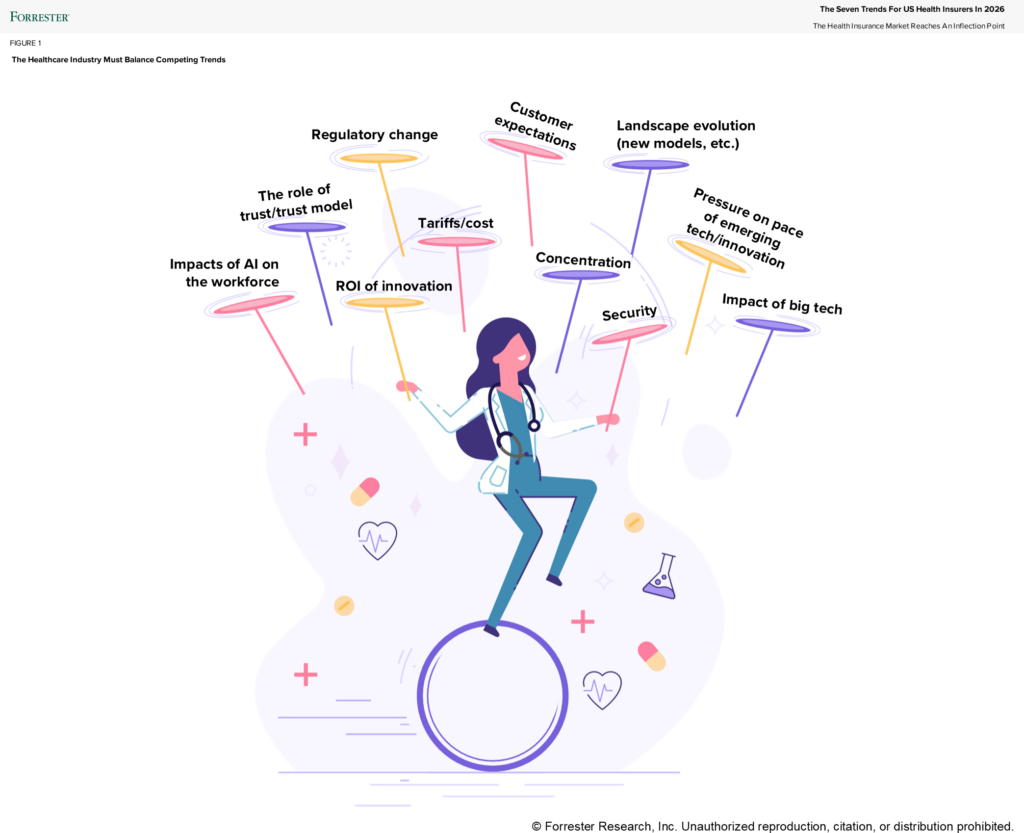
Healthcare Providers And Insurers Face Many Common Challenges
Among our top trends for healthcare providers and health insurers, there are five critical, unavoidable realities:
- Trust has become existential. For insurers, member skepticism is high, impeding growth. Billing surprises, opaque coverage decisions, and service failures have made trust a fragile asset. Rebuilding it now depends less on messaging and more on operational competence: clear communication, dependable experiences, and accountability when things go wrong. Providers face a different but equally serious trust challenge. Patients are becoming de facto data brokers, sharing health information across apps, AI tools, and networks that introduce new privacy and safety risks. For clinicians, trust hinges on outcomes, stewardship of data, and clinical decision‑making — especially as AI becomes rapidly embedded in care delivery.
- AI must move out of pilot mode. Both sides are trying to escape AI experimentation purgatory. Payers are shifting from innovation theater to creating solutions with tangible value, obtained mainly through productivity gains and cost reduction. Providers are adopting AI‑enabled navigation, documentation, and decision support tools, but many are discovering that speed has outpaced readiness, leaving them with new safety concerns, unclear accountability, and risk of eroding consumer trust. They need to focus on governance as regulatory scrutiny and budget pressures intensify.
- Volatility is the norm. Neither insurers nor providers can count on stability. Insurers are facing policy whiplash that reshapes benefits, pricing, and even market participation. Consolidation, vertical integration, and selective exits add to the ambiguity brought on by policy changes. Providers are subject to heightened M&A scrutiny, reimbursement uncertainty, and regulatory that favors disciplined partnerships over large‑scale consolidation.
- Access and affordability are mission-critical. Providers are consumed by access breakdowns. Primary care shortages, long wait times, and care leakage to direct‑to‑consumer platforms and medical tourism are eroding continuity and pressuring revenue. Their response centers on rebuilding access through on‑demand models, virtual care, and redesigned digital front doors that prioritize speed to care. Insurers, by contrast, are confronting an affordability crisis. Younger, healthier consumers are opting out of traditional coverage completely, threatening risk pool stability. Health insurers need to respond with new coverage designs, pricing models, and benefit structures to prevent long‑term erosion.
- AI-powered care navigation is the new battleground. Providers increasingly see answer engine optimization (AEO) and care navigation as the new front door to the health system — one that big tech and public AI tools are trying to own. For providers, the risk is high, including missed emergent escalations, inequitable outcomes, and liability when AI-driven guidance goes wrong. Insurers are racing to keep their influence as AI becomes a gateway to plan selection, care decisions, and health guidance. Payers are racing to shape member behavior and perceptions before public tools capture mindshare and disintermediate them entirely.
What 2026 Means For Healthcare Leaders
Trust, AI, access, affordability, and regulation are tightly coupled challenges — and missteps in one area amplify risk everywhere else. This year will reward leaders who stop treating these trends as isolated initiatives and start designing for resilience at scale. Healthcare’s next phase will be defined by those who can scale AI responsibly, earn trust through execution rather than empty promises, and adapt continuously in an environment where no plate spins on its own.
Forrester clients should read our reports now to learn about The Seven Trends For US Healthcare Providers In 2026 and The Seven Trends For US Health Insurers In 2026, and they can also schedule a guidance session to discuss how their own organization can respond at this critical moment. Use Forrester AI to explore each trend in more depth and connect related research.
Not a client? Learn how Forrester can help.
Related Forrester Content
Categories