Global Manufacturing’s Software-Led Reset: From Cost Advantage To Adaptive Manufacturing
We’ve been working on a technology investment forecast for global manufacturing with our colleague Paul Miller. For decades, manufacturers used to compete through scale, labor arbitrage, and optimized global production networks. But tariffs, geopolitical fragmentation, workforce shortages, volatile energy prices, and rising customer expectations are now forcing them to rethink value creation. Software-defined manufacturing, industrial AI, manufacturing automation, and connected operations offer a new path to manufacturing competitiveness, flexibility, and resilience. The manufacturers that outperform through 2030 won’t simply invest in technology — they’ll use smart manufacturing technologies to fundamentally redesign how they operate, innovate, and respond to change.
Manufacturing Is At The Start Of A Productivity Reset
Manufacturing remains highly productive, but growth has stalled in many regions. US manufacturing labor productivity, for example, remains below 2017 levels despite significant technology investment, while demographic pressures and workforce shortages are shrinking labor availability across major manufacturing economies.
Manufacturers Must Produce More Value With Fewer Workers
Workforce shortages create a critical challenge: Manufacturers must produce more value with fewer workers. Historically, manufacturers would have relocated to lower-cost regions. Increasingly, they’re turning to software, automation, and AI to improve throughput, increase flexibility, optimize assets, and reduce reliance on labor-intensive processes. The result is a shift from labor-led productivity to software-led productivity.
Software Is Becoming The New Factory Differentiator
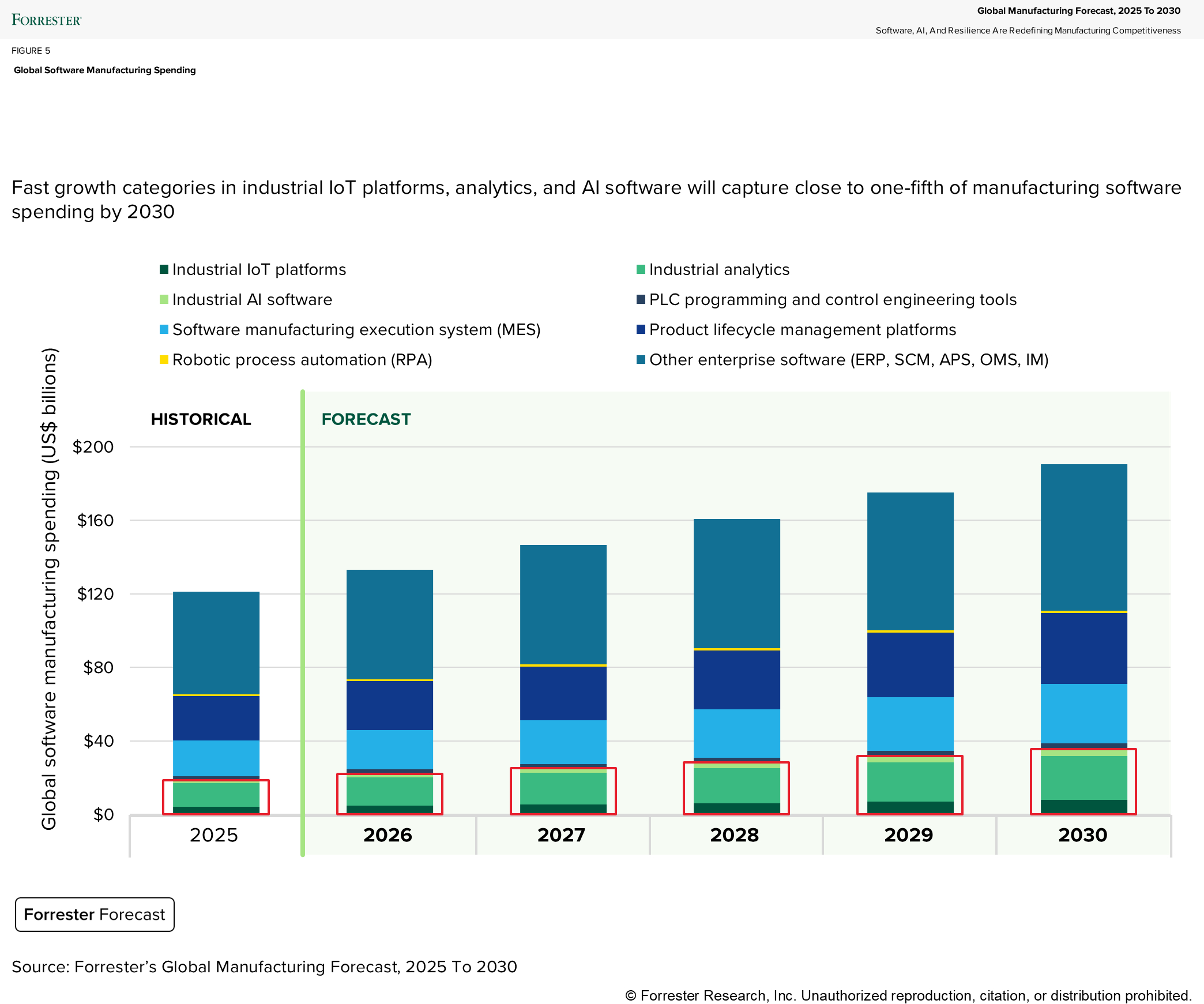
Industrial software has traditionally been a type of infrastructure: essential but rarely strategic. Forrester expects software to be the fastest-growing manufacturing technology category and to gain a significantly larger share of technology spending by 2030. Industrial AI, analytics, industrial IoT, and software-defined operations are turning software from a support function into a competitive differentiator.
Software-Defined Factories Adapt To Demand Instability
The rise of software-defined manufacturing allows factories to become more adaptable. Rather than optimizing for a single product at maximum volume, manufacturers can increasingly produce a wider variety of products, adjust production more rapidly, and respond faster to shifting demand. Flexibility is critical because demand variability, rather than capacity bottlenecks, is often the main obstacle to full factory utilization.
AI Rewires Manufacturing Operations
Industrial AI is advancing beyond experimentation. Leading manufacturers already apply AI across engineering, software development, operations, maintenance, and supply chains to accelerate product development, improve asset reliability, optimize production planning, and reduce costs.
Manufacturers’ Caution Constrains Agent Deployment
Manufacturing’s AI journey remains in its early stages. Our data indicates plans to increase AI adoption, but cybersecurity, intellectual property protection, and operational risk concerns constrain appetite for autonomous AI agents. To minimize risk, manufacturers must balance innovation with disciplined governance, data management, and human oversight.
The Workforce Challenge Isn’t Going Away
Manufacturing faces a structural labor challenge. Forrester estimates that the global manufacturing workforce has shrunk by approximately 25 million workers over the past decade. Aging populations, demographic change, and skills shortages are reshaping labor markets across North America, Europe, Japan, and China. Automation can’t solve the problem alone. Manufacturers need more engineers, technicians, software specialists, data professionals, maintenance experts, and digitally enabled frontline workers. They must also reskill existing employees to work effectively alongside AI-powered systems and advanced automation. Competitive advantage in the future will be less about the size of a workforce and more about the ability to leverage digital capabilities.
Regional Manufacturing Strategies Continue To Diverge
Manufacturing remains global, but manufacturing strategies are becoming increasingly regional:
- The US is prioritizing advanced manufacturing, semiconductor production, and manufacturing reshoring.
- China is accelerating industrial automation, robotics, semiconductor self-sufficiency, and higher-value manufacturing sectors.
- Europe is focusing on industrial automation, energy transition investments, defense manufacturing, and supply chain resilience.
- Mexico is benefiting from nearshoring, North American supply chain regionalization, and growth in high-value manufacturing exports.
- Japan is addressing demographic decline through manufacturing automation, robotics, and a shift toward higher-value production.
While priorities differ, the common theme is clear: Every region is investing in technology to offset workforce pressures and increase resilience.
Competing On Adaptability Rather Than Cost
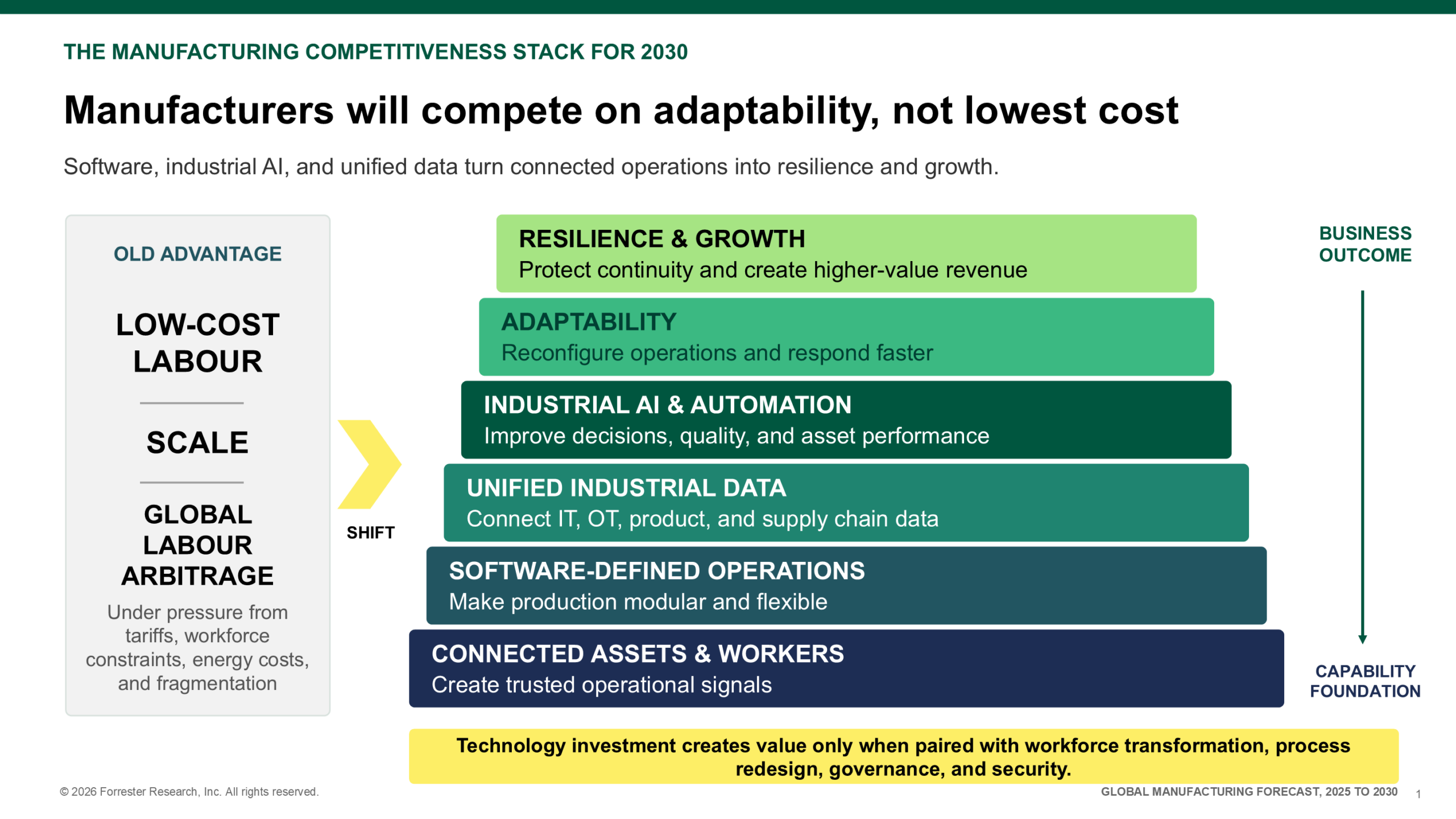
Perhaps the most important lesson for manufacturing leaders is that manufacturing competitiveness will increasingly depend on adaptability rather than cost advantage. As manufacturers respond to supply chain disruption, workforce constraints, and regionalization, smart manufacturing, automation, and software will become critical to operational resilience.
The most successful manufacturers will:
- Build software-defined factories that enable flexible and adaptable manufacturing.
- Modernize manufacturing execution systems, product lifecycle management, and industrial data platforms.
- Establish strong IT-OT integration across manufacturing operations.
- Invest in industrial AI, manufacturing automation, and advanced analytics.
- Strengthen manufacturing cybersecurity, governance, and operational resilience.
- Reskill workers for increasingly digital and AI-enabled manufacturing operations.
In other words, manufacturing transformation requires organizational change to accompany technology investment.
Moving From Brute Force To Brain Force With A New Manufacturing Architecture
Manufacturing is evolving from brute force to brain force. Historic reliance on labor-cost advantages and production scale is yielding to modern software-defined manufacturing that offers superior flexibility and resilience. Manufacturers that combine industrial AI, software-defined operations, IT/OT integration, workforce transformation, and strong governance will outperform their peers through the rest of the decade. Those that treat technology as a standalone investment rather than the foundation of new manufacturing operating models risk falling behind.
The next generation of manufacturing leaders won’t win because they make products more cheaply — they’ll win because they can adapt faster than everyone else.
We’re always interested in hearing your perspective on manufacturing transformation. Please feel free to schedule a guidance session or inquiry call.