Launching The Agentic Development Platforms Vendor Landscape, Q3 2026
Agentic development platforms (ADPs) move AI-enhanced development from experimentation to enterprise decision-making. As AI coding assistants evolve into platforms that can coordinate agents, manage context, and automate work across the software development lifecycle (SDLC), technology leaders need a clearer view of which vendors matter, how they differ, and where the market is heading. ADPs are not general-purpose platforms for anyone to build any type of AI agent, nor are they application generation platforms that enable business users and professional developers to create applications through natural language prompts, vibe coding, and low-code/no-code programming languages. Instead, they are software development platforms that use agentic AI to help teams build software of all kinds — from user interfaces and application logic to infrastructure and backends — with agents.
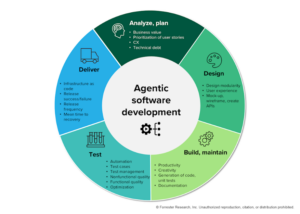
Code Generation Is The Core Capability And Go-To-Market Entry Point, But ADPs Go Well Beyond It
The Agentic Development Platforms Landscape, Q3 2026 highlights a fast-expanding market of agentic development platforms that go well beyond code generation — even as code generation remains central to their capabilities and go-to-market positioning. Software engineers use these platforms to write comprehensive, complex enterprise software. ADPs increasingly support core use cases such as code autocompletion and generation, unit test generation, and code explanation. They also extend into more strategic capabilities such as understanding large codebases, modernization, SDLC agent orchestration, context engineering, pull-request reviews, spec-driven development, and more.
By analyzing 25 ADP solutions, one of the report’s clearest signals is that differentiation is shifting. As foundation models make basic code generation more widely available, vendors will compete less on coding assistance alone and more on orchestration, enterprise context, governance, model agility, cost transparency, and the ability to connect AI agents across the full SDLC. In short, the market is moving from individual developer productivity toward governed automation for full enterprise teams that works across multiple workflows.
Technology Leaders Need A Clear Capability View To Make The Right Choice
For software development and engineering leaders, this means vendor evaluation must become more disciplined. Polished demos are not enough. Buyers should start with real-world pilots, validate impact in their own toolchains, demand clarity on pricing and consumption models, and require strong controls for data privacy, code ownership, auditability, human oversight, and enterprise governance before scaling adoption.
The market’s next phase will favor vendors that turn agentic development from a set of clever assistants into trusted software delivery infrastructure. Leaders should use the Landscape report to understand vendor focus, compare deployment and market presence, identify the use cases that matter most to their organization, and build a roadmap that moves from controlled pilots to SDLC-wide adoption.
Stay Tuned And Reach Out
I’ll be working next on the Forrester Wave™ evaluation on ADPs (planned to release in Q4 2026), comparing the top performers based on important client drivers and needs.
Interested in discussing how agentic development platforms fit into your software delivery strategy? If you are a Forrester enterprise client, please schedule a guidance session so we can discuss your priorities, vendor evaluation questions, adoption roadmap, and governance needs. If you are a vendor in this space and want to make sure Forrester understands your capabilities, roadmap, and market traction, please request a briefing.
Related Forrester Content