Your Cloud Operations Aren’t Ready For AI
Is your system working?
That’s the question that teams have been trained to answer for decades. In today’s AI-enabled ecosystems, that question is insufficient. An AI service can be available, responsive and technically healthy while still producing wrong answers and drifting away from expected behavior. Worse, it can violate policy and burn through your budget without your awareness. You know the system is up and running, but you may not know that it’s failing you.
The definition of “healthy” has changed and cloud operations must change with it.
Stop treating AI as another cloud workload
Structurally, AI workloads are different. GPU-centric compute introduces new capacity and scheduling constraints while AI workloads can create much more variable demand. Data movement and model behavior become financial operating concerns, not just data management issues, because your costs are now tied to how models and workloads behave.
Most concerning is how AI systems fail. Failures may surface as gradual degradation rather than a clear outage. That makes problems easier to miss or dismiss as low priority until the impact is significant. All this fundamentally changes what operations teams must observe, what they must optimize and what they consider a failure.
Observability is your connective tissue, not just your monitoring layer
The first step is recognizing that AI-enhanced observability is not the same as observability for AI. AI-enhanced observability uses AI itself to improve operations through capabilities such as anomaly detection, correlation, summarization and eventually remediation.
Observability for AI, however, is different. Here, the AI itself is what is being observed. We’re observing things such as model drift, output quality, prompts, agent behavior, token consumption and cost, and business outcomes. The industry tends to blur these concepts together when it should instead recognize the expanding chain of operational visibility: infrastructure à application à model à agent à business outcome.
Resilience must account for AI behavior
Earlier, we asked whether your system was running. Resilience requires another question: Can you restore the service to a trustworthy state?
Traditionally, restoring the application or infrastructure was the measure of recovery. That’s no longer sufficient. Recovery must include model resynchronization, pipeline restarts, cache restoration, controlled rollback and other AI dependencies.
More importantly, what do you recover when nothing technically failed? An AI service can remain operational while producing unreliable or unsafe outputs. Restarting the application or infrastructure may not fix the problem. AI resilience now means restoring trustworthy behavior. You can’t just focus on restoring uptime.
What it means: Operations must move from system health to outcome health
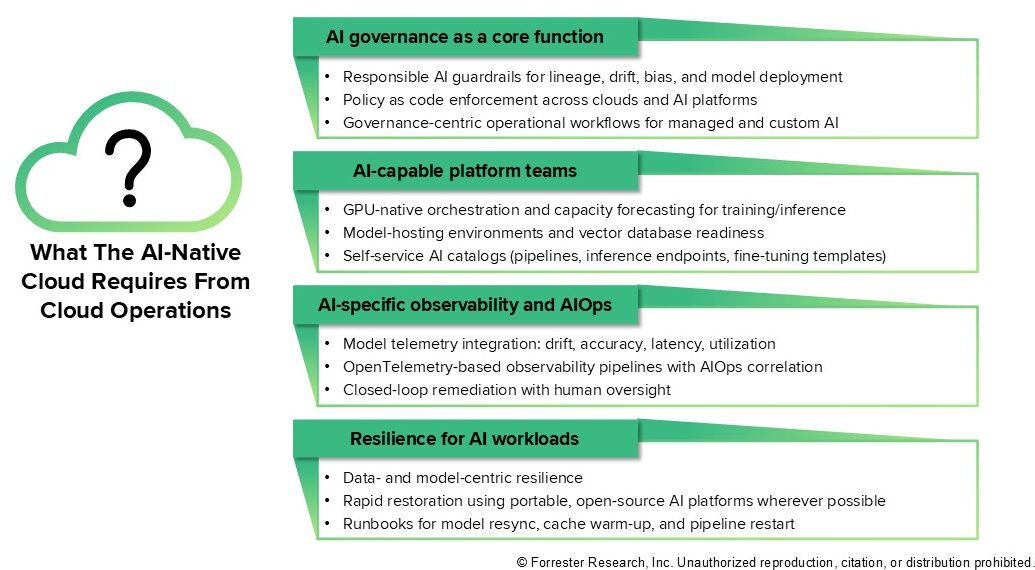 AI-native operations must move from system health to outcome health. That requires visibility into whether AI services remain trustworthy, economically sustainable, and aligned with intended business outcomes. Enterprises must retool operations for the AI-native cloud, and modernize cloud operations for AI workloads while improving visibility, controlling costs, and strengthening resilience.
Join The Conversation
I invite you to reach out to me through social media if you want to provide general feedback. If you prefer more formal or private discussions, email inquiry@forrester.com to set up a meeting! Access my bio on Forrester.com to follow my research and continue the discussion. You can also reach out to Charlie Dai, who was instrumental on this research. For resilience specific questions and research, follow and reach out to Courtney Nash.
Related Forrester Content