Americans Feel Miserable. Why Do They Keep Spending?
Consumer confidence languishes near historic lows, surveys drip with despair, and media narratives fixate on fragility. And yet, consumers open their wallets, and corporate profits roll in. This is not a passing contradiction. It is the defining paradox of today’s “pessimism economy.”
Our new research — Down But Not Out: Growth Strategies For The Pessimism Economy — shows that four forces hold this uneasy equilibrium in place.
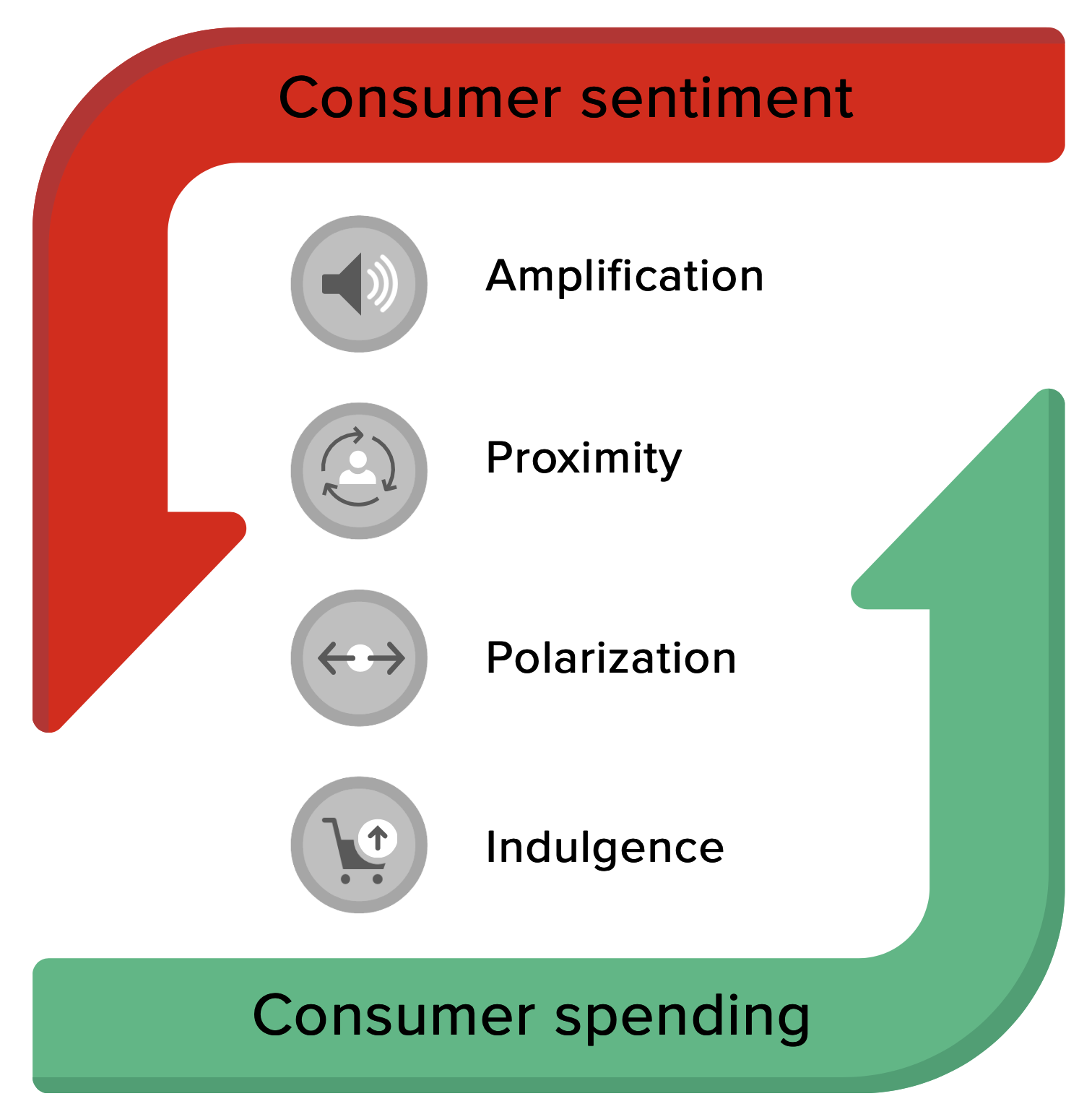
1. Amplification: Bad News, Loudly Told
Economic bad news now travels faster, farther, and with more certainty than good news ever did. The media has long favored calamity, but post‑pandemic volatility has supercharged the effect. Consumers absorb a steady diet of inflation scares, recession warnings, and geopolitical tremors, even as wage growth persists. The result is sentiment untethered from fundamentals.
2. Proximity: Reality Is Personal
Macroeconomics may dominate headlines, but microeconomics governs behavior. Consumers do not consult The Wall Street Journal before buying sneakers or booking flights. They ask simpler questions: Do I still have a job? Can I carry this payment? Are prices tolerable for me? For many households, especially in recent years, the answers have been good enough to keep spending — regardless of how bleak the national mood appears.
3. Polarization: The Few Carry The Many
National consumption increasingly rests on a narrow base. A relatively small, affluent segment now accounts for a striking share of total spending, buoyed by strong housing markets, rising equities, and faster income growth. Growth is being powered from the top down, even as anxiety spreads from the bottom up. This is not a clean split between rich and poor, however; the middle still matters a lot. And what’s of interest to most brands is whether their customer, not the average consumer, is spending.
4. Indulgence: Buying Relief
When the future feels compromised, the present becomes precious. Consumers respond to chronic uncertainty not by retreating entirely, but by reallocating spend toward emotional payoff — small luxuries, experiences, moments of escape. Younger cohorts, in particular, face delayed milestones and dimmer paths to traditional wealth. They compensate rationally: less saving for a distant tomorrow, more spending for today.
The Pessimism Paradox
Put together, these forces explain why pessimism no longer predicts pullback. Consumers feel battered by the world, but many remain capable — even determined — to spend. For businesses, the lesson is blunt. The danger is not a recessionary collapse but a strategic misreading: believing that sentiment tells the whole story.
In the pessimism economy, gloom is loud, growth is uneven, and opportunity hides in plain sight — for those precise enough to see it.
Looking For More?
The extensive data and analyses (such as consumer sentiment, retail growth and profitability, K-shaped curves, income and demographic breakdowns, and more) that led to the formulation of these four forces are in the report, Down But Not Out: Growth Strategies For The Pessimism Economy.
Follow my research: Go to my Forrester bio and click “Follow.”
Chat with me: If you are a Forrester client interested in discussing these topics, please schedule time with me for an inquiry or a guidance session.
Plan a session: If you are a Forrester client looking to host a strategy session on a related topic, please contact your account team or email me at dchatterjee@forrester.com.